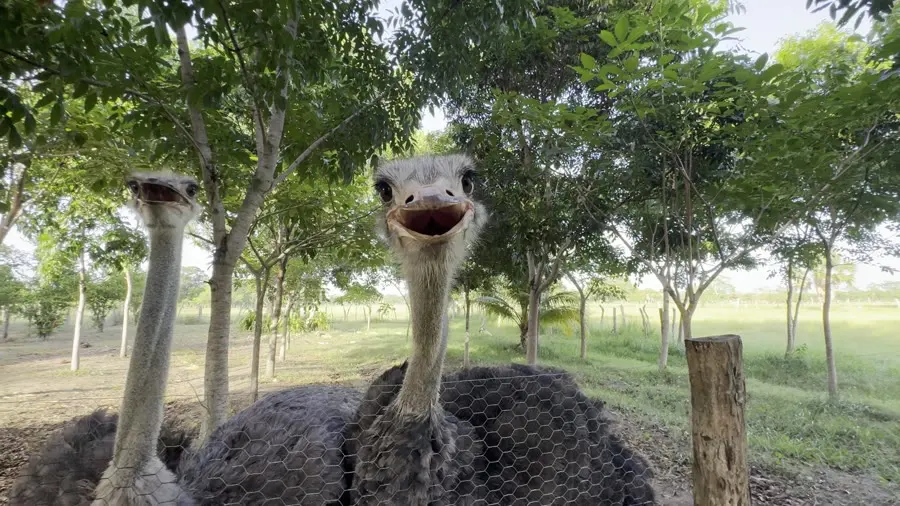
They arrived from Mérida capital y ciudad más poblada del estado de Yucatán, México —yes, Méridacapital y ciudad más poblada del estado de Yucatán, México again— when they were just 2 months old, about the size of a large turkey or a big hen. Now, with 1 year and 4 months, they're giants and have no intention of going unnoticed. Luke and Leia are ostriches, and from day one, they made it clear that in this house, the one setting the party pace has feathers.
They're extremely social animals: naturally nosy, they'll approach anything that moves —visitors, cameras, the remote control, you name it— and never miss a family gathering. If there are new people in the yard, you can bet an ostrich will show up within minutes.
That being said, although they're almost as tall as an adult, an ostrich can live between 30 and 40 years, so they're just in their equivalent of kindergarten. We still need to treat them like what they are — a pair of kids who, due to a genetic accident, happen to be 6 feet tall.
Before moving in, they made one last visit to the farm where they were born — to meet cousins, aunts, and the rest of the family— before starting their new life as part of the family.
"In this house, the one who sets the party pace has feathers."
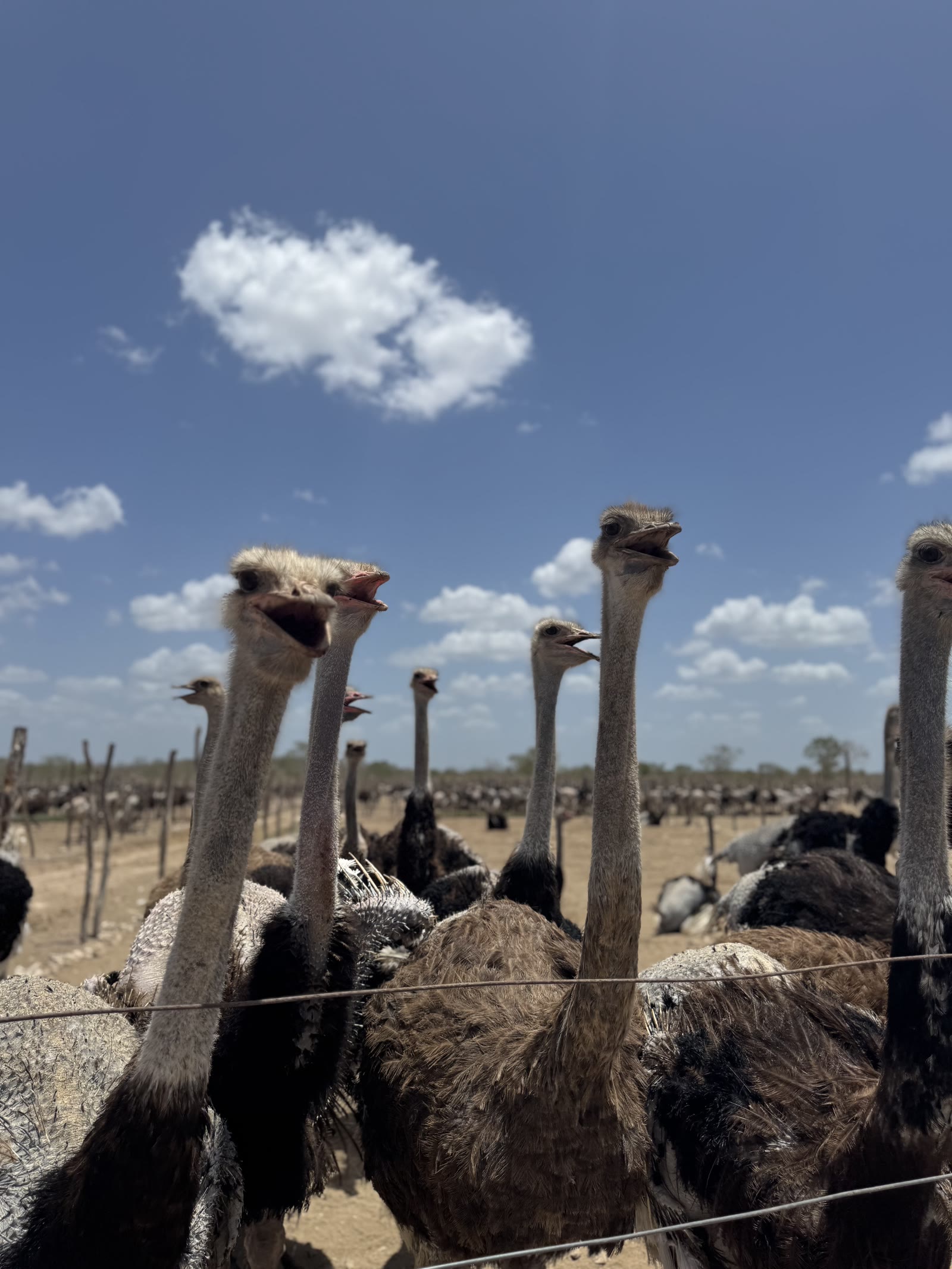
Self-proclaimed security manager
Luke
Weakness: shiny objects. Escorts any visitor with a new lawn mower.
See on Wikipedia ↗Tap the credential to flip it
Luke
Luke thinks he's the head of security for the land. He stands by the gate when there are visitors, stretches his neck as far as he can, and observes as if he's checking credentials. The first time the gardener came with a new lawn mower, Luke followed him at a safe distance all afternoon, apparently convinced that supervising the operation was his job.
He also has a weakness for shiny objects: a pair of sunglasses left on the table won't last five minutes with Luke around. More than one visitor has had to negotiate —from a distance, with a lot of patience— the return of their car keys.
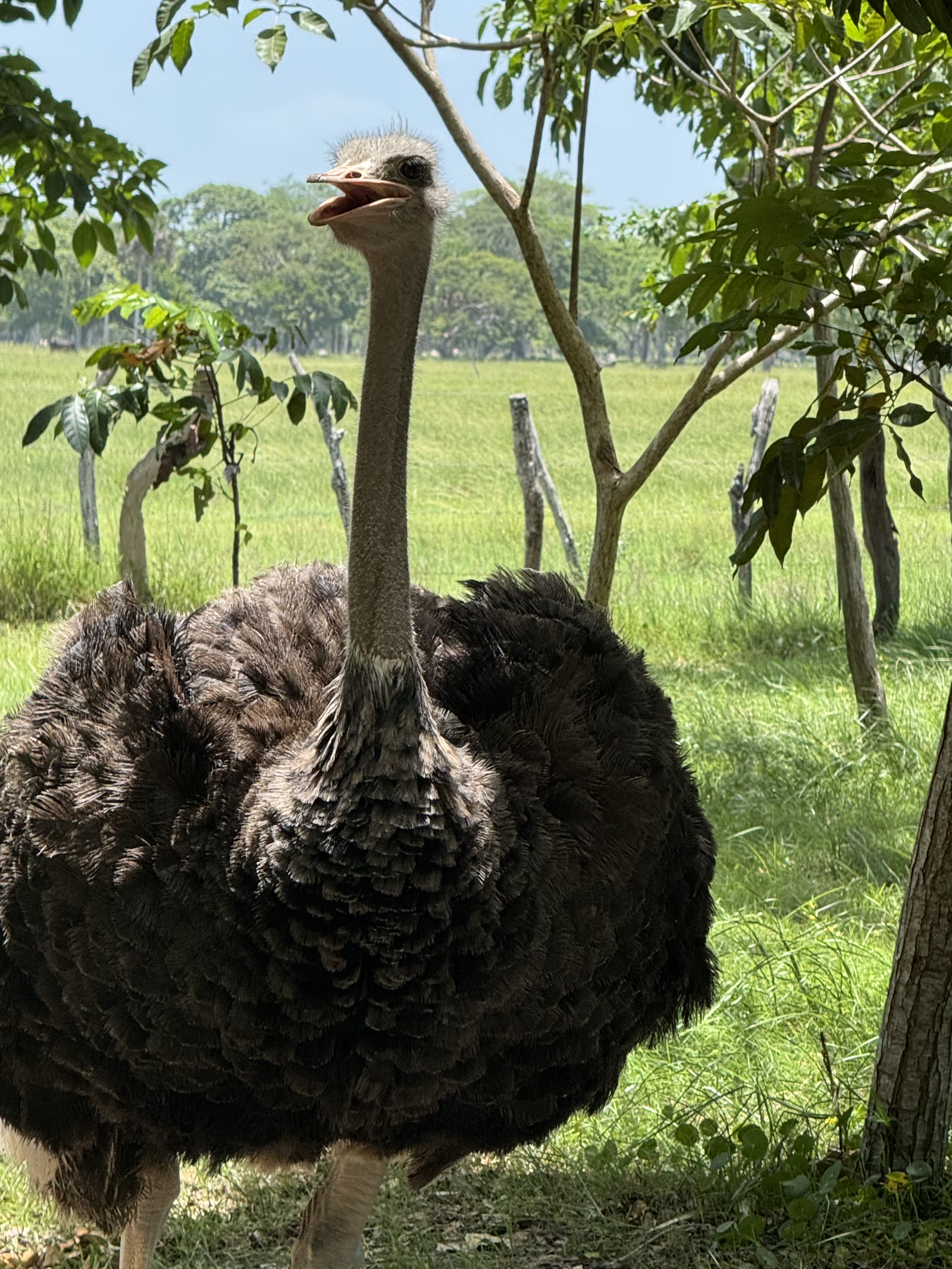
The life of the party
Leia
Runs in as soon as there's music. Investigates other people's bags without asking permission.
See on Wikipedia ↗Tap the credential to flip it
Leia
Leia is the official party animal. As soon as she detects music or loud laughter, she shows up running from the other end of the land as if she'd been formally invited. At a family dinner, she planted herself right in the middle of the group, between the chairs, like a guest waiting for someone to pass her something from the table.
She's also the most curious about investigating bags, backpacks, and anything someone has left on the grass by mistake. Her style: approaching slowly, with all the calm in the world, and then looking straight into your eyes as if to say, 'this is mine now'.
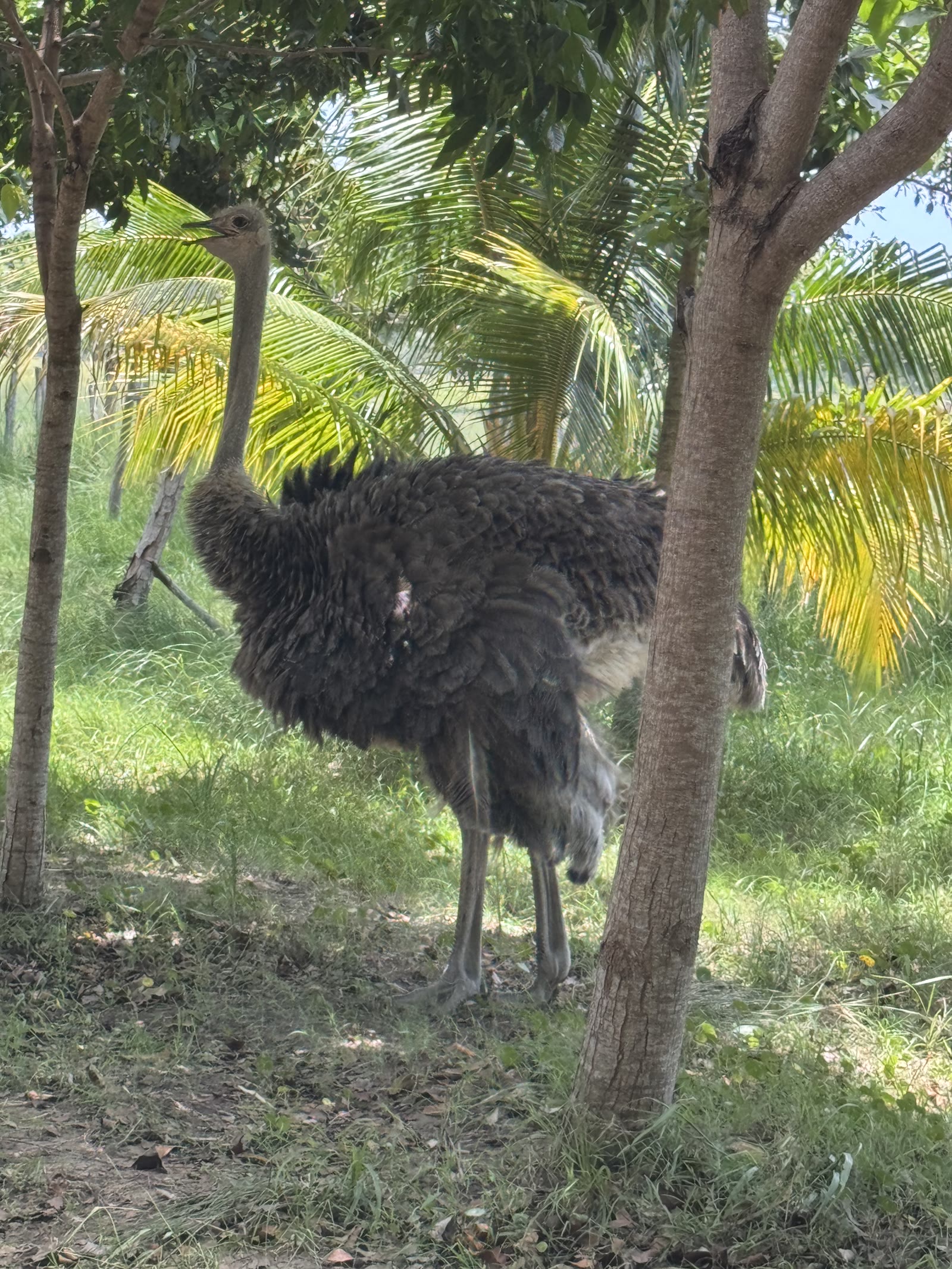
Up close
Sus patas (sí, también son enormes)
Friends of the house
Yoda
Tropidacris cristata
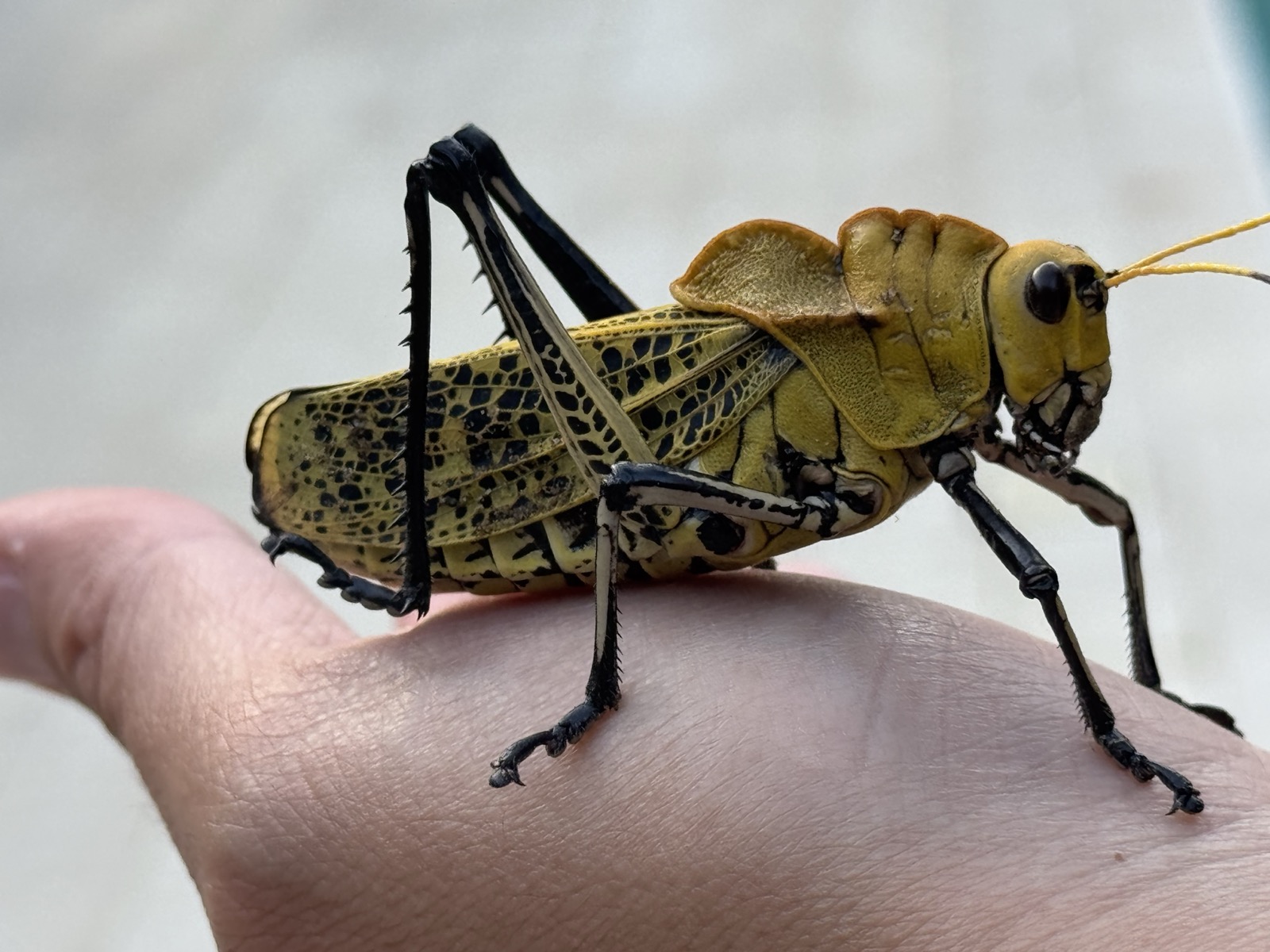
Silent council member
Yoda
Giant grasshopper. Doesn't give advice, just stays very quiet.
See on StarWars.com ↗Tap the credential to flip it
Luke and Leia also have unexpected friends on the land. The most memorable so far: a giant grasshopper that one afternoon decided to land on the terrace wall and stay there, motionless, the size of a full hand.
We named it 'Yoda' — given its greenish-yellow tone, enormous size for an insect, and absolute calm as it let itself be picked up, the name felt inevitable. Unlike the Jedi master, Yoda doesn't dispense advice: it just stays still, watching everything with those huge eyes, until it decides to jump and reminds us that, if it wanted to, it could disappear in an instant.
"Yoda doesn't dispense advice: it just stays still, watching everything with those huge eyes."
Given its size, the net pattern on its wings, and the orange border on its thorax, everything points to Yoda being a giant grasshopper (Tropidacris cristata) — one of the largest grasshoppers in the Americas, whose hind wings are an intense red that's only visible when it flies.
- It's one of the largest grasshopper species in the American continent, reaching up to 14 centimeters in length.
- It lives from Mexico to South America, in tropical and jungle climates — like southeastern Mexico.
- At rest, it looks yellow-green with black spots, camouflaged among dry leaves — but when it flies, it displays bright red rear wings to surprise predators.
- Its hind legs allow it to jump distances far superior to its own body size.
- It feeds mainly on leaves from a wide variety of tropical plants.
- It's completely harmless to people — it doesn't bite or sting, although its size can be intimidating at first sight.
- It can live over a year in the wild.
Friends of the house
Red Leader y Red Two
Caracara plancus
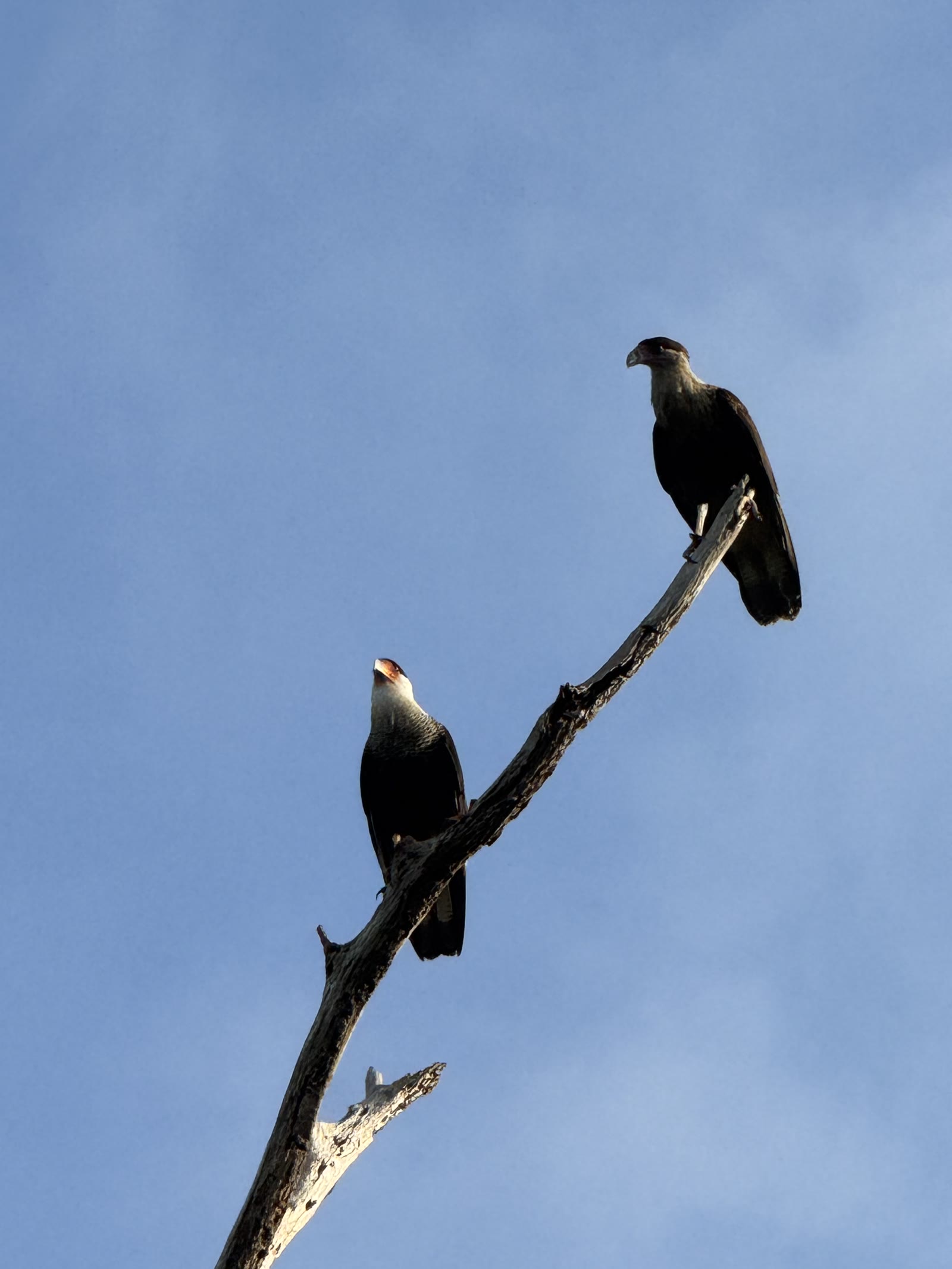
Flight squad
Red Leader & Red Two
Crested caracaras. Always in formation of two.
Tap the credential to flip it
The other regular neighbors: a pair of birds of prey that perch almost daily on the same dry branch, looking out over the entire grounds as if they were in charge. We've named them 'Red Leader' and 'Red Two' — squadron names, because they always appear flying in formation.
"They always appear flying in formation of two."
Given its dark body, cream-colored head and neck, and orange skin around the beak, everything points to Red Leader and Red Two being crested caracaras (Caracara plancus) — birds of prey very common in southeastern Mexico, although they're often simply called 'eagles' due to their size and demeanor.
- Despite its eagle-like appearance, it's actually a hawk relative — more closely related to hawks than true eagles.
- It's one of the most common birds of prey in southeastern Mexico, easy to spot perched on dry branches or posts at the edge of fields and roads.
- It feeds mainly as a scavenger, but also hunts small prey like insects, reptiles, and rodents.
- Unlike most birds of prey, it walks and runs with ease on the ground while foraging for food.
- It usually lives in pairs for life and defends the same territory for years.
- It's very opportunistic: it won't hesitate to approach human-inhabited areas if food is available.
- It can live for over 25 years in the wild.
Friends of the house
Ezra, Zeb, Sabine, Hera... y Jacen
Bubalus bubalis
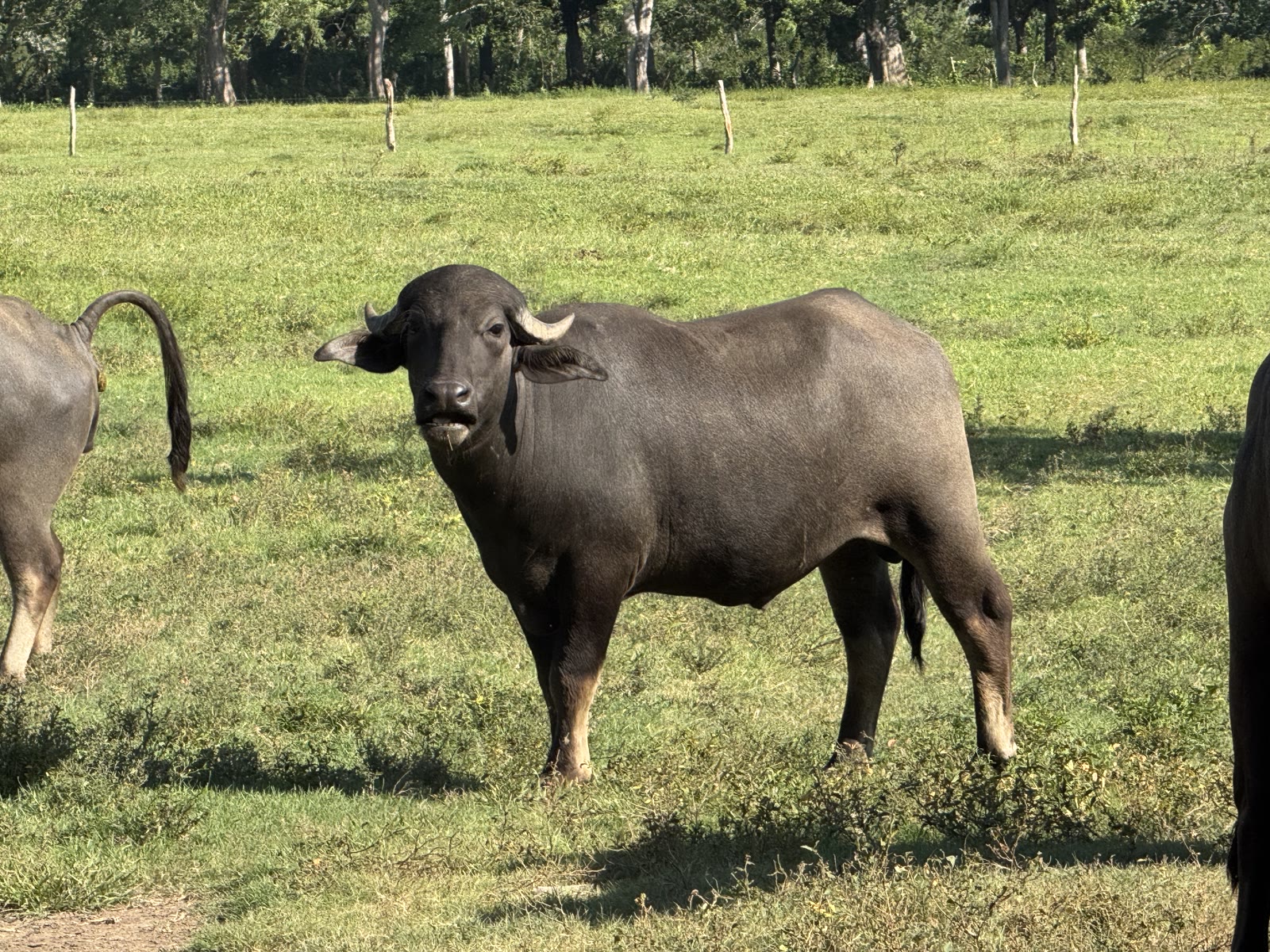
The rebel battalion
Ezra, Zeb, Sabine & Hera
Water buffalo. Now with a new recruit: Jacen.
See on StarWars.com ↗Tap the credential to flip it
The land also has water buffalo — with names that any fan of a rebel crew would recognize immediately: Ezra, Zeb, Sabine... and Hera, the only one in the group with a grayish tone that looks almost green in the morning light, like her namesake.
Among the ostriches, the grasshopper, the squadron eagles, and now a full battalion with names of armed rebels, with these friends, I'm in trouble — if one night they decide to organize, I'd better have a good lawyer and a back door.
What does worry me a bit is that, with so many names from the same side, at some point they might decide that the only one who's unnecessary — the one walking around in a dark suit giving orders— is me. Hopefully, no one will call a real rebellion before dawn.
"If they ever decide to get organized, you'd better have a good lawyer and a back door."
¡Bienvenido, Jacen! 🎉
And today the herd grew! Hera had her calf — a healthy young one that's already standing and walking on its own. With Hera as mom and the Rebel theme being taken so seriously in this house, there was no other possible name: it's called Jacen, like the son Hera Syndulla has in the series canon.
...
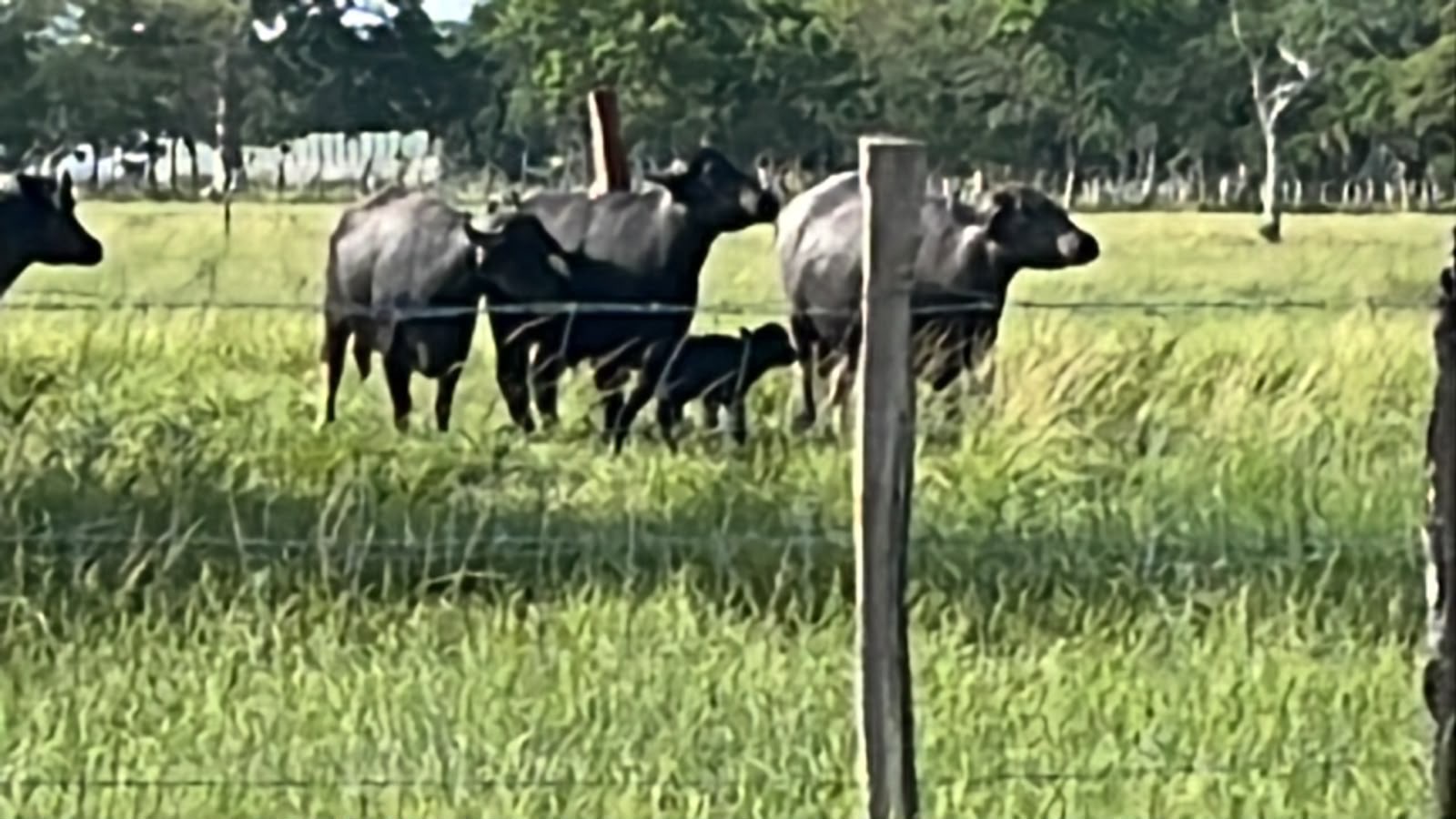
They're water buffalo (Bubalus bubalis) — domesticated thousands of years ago in Asia, now common on farms in southeastern Mexico.
- It can weigh over 700 kilograms in adulthood.
- It loves water and mud — they help it regulate its temperature and protect itself from insects.
- Its horns can measure over a meter from tip to tip.
- It's a social animal that lives in herds with a well-defined hierarchy.
- It's used in many parts of the world to produce milk, meat, and as a work animal in the field.
- It can live between 20 and 25 years.
- It's more resistant to extreme heat than traditional cattle.
- A newborn calf can stand and walk just hours after birth.
Friends of the house
Qui-Gon Jinn
Alouatta pigra
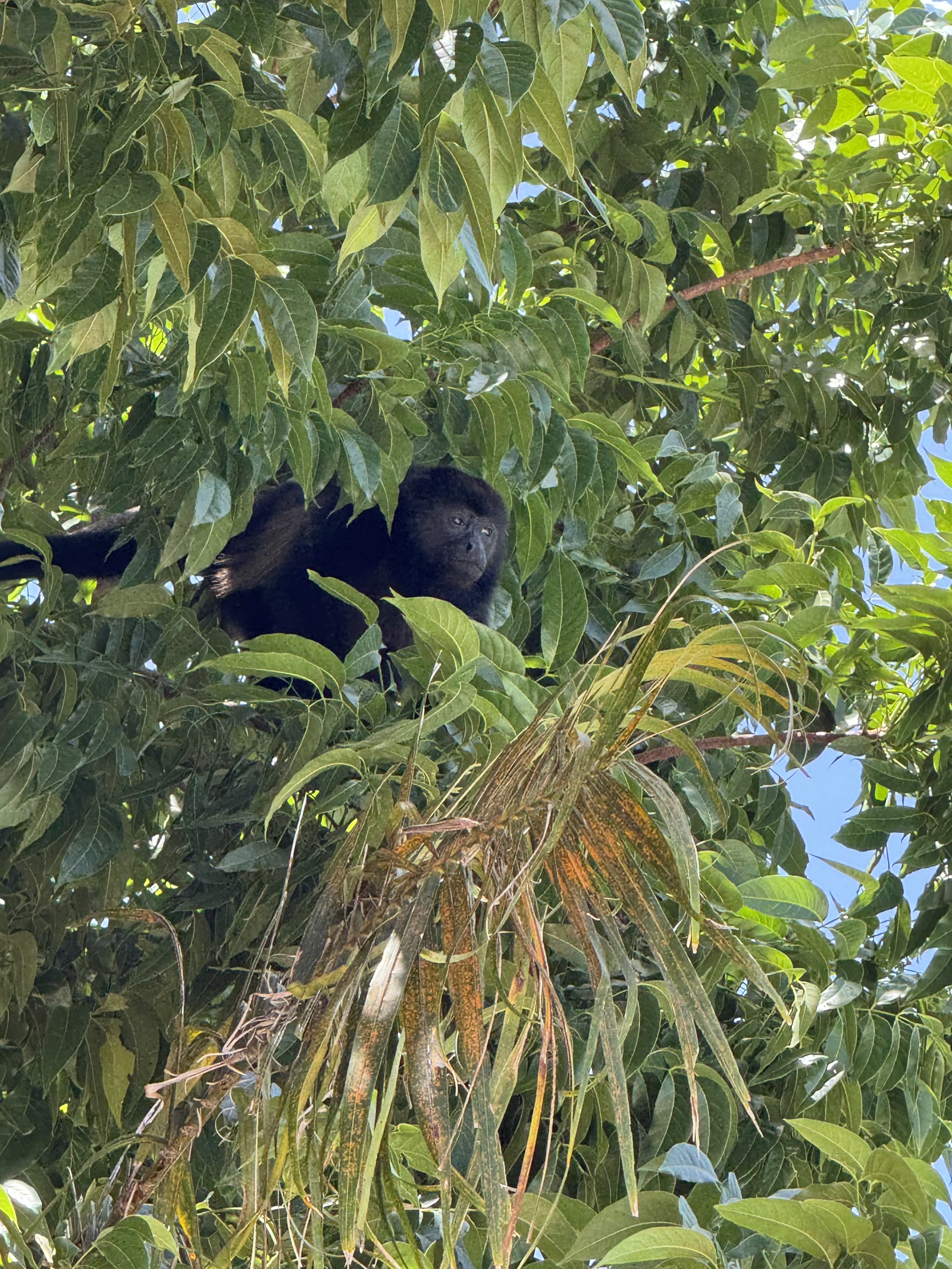
The most serene on the council
Qui-Gon Jinn
Howler monkey. Heard before seen — up to 2 km away.
See on StarWars.com ↗Tap the credential to flip it
The latest addition to the local fauna is a black howler monkey that started appearing in the tops of the tallest trees — usually hidden among the leaves, only revealing itself for a few seconds before disappearing again.
Before we saw it, we'd already heard it: the howl of a howler monkey can be heard from one to two kilometers away, and the first time it echoed across the land, more than one person wondered if something had happened to the newborn calf. No — it was just the new neighbor announcing its presence.
We named it Qui-Gon Jinn — the most serene Jedi of all, the one who never loses his calm, even when the rest of the Council is upset. It fits: the monkey stays still in the highest branches, observing everything as if in its own private meditation, without coming down to mix with the rest of the cast — ostriches, giant grasshoppers, a squadron of caracaras, and now a full battalion of buffaloes with names of armed rebels.
"The most serene Jedi of all, the one who never loses his calm."
Due to its completely black fur, long prehensile tail, and dense beard under the jaw, everything points to Qui-Gon being a black howler monkey or Yucatecan saraguato (Alouatta pigra) — the largest primate in Mexico after humans, native to the jungle of the Yucatán Peninsula.
- It's the largest primate in the entire American continent, after humans.
- Its howl — a deep roar that serves to mark territory and warn other groups — can be heard from one to two kilometers away.
- It lives almost exclusively in the trees, in the low and medium forests of southeastern Mexico: Yucatán, Campeche, Quintana Roo, Chiapas, and Tabasco.
- It has a prehensile tail, as long as its own body, which it uses as a fifth limb to hold onto while eating.
- The male is noticeably larger than the female and is the one that emits the loudest howls.
- It feeds mainly on leaves, as well as fruits and flowers.
- Females reach sexual maturity between 26 and 30 months of age; males, between 36 and 40.
- It's classified as Endangered by the IUCN and protected by the Mexican standard NOM-059 — seeing one up close is no small thing.
Friends of the house
El maestro Plo Koon
Procyon lotor
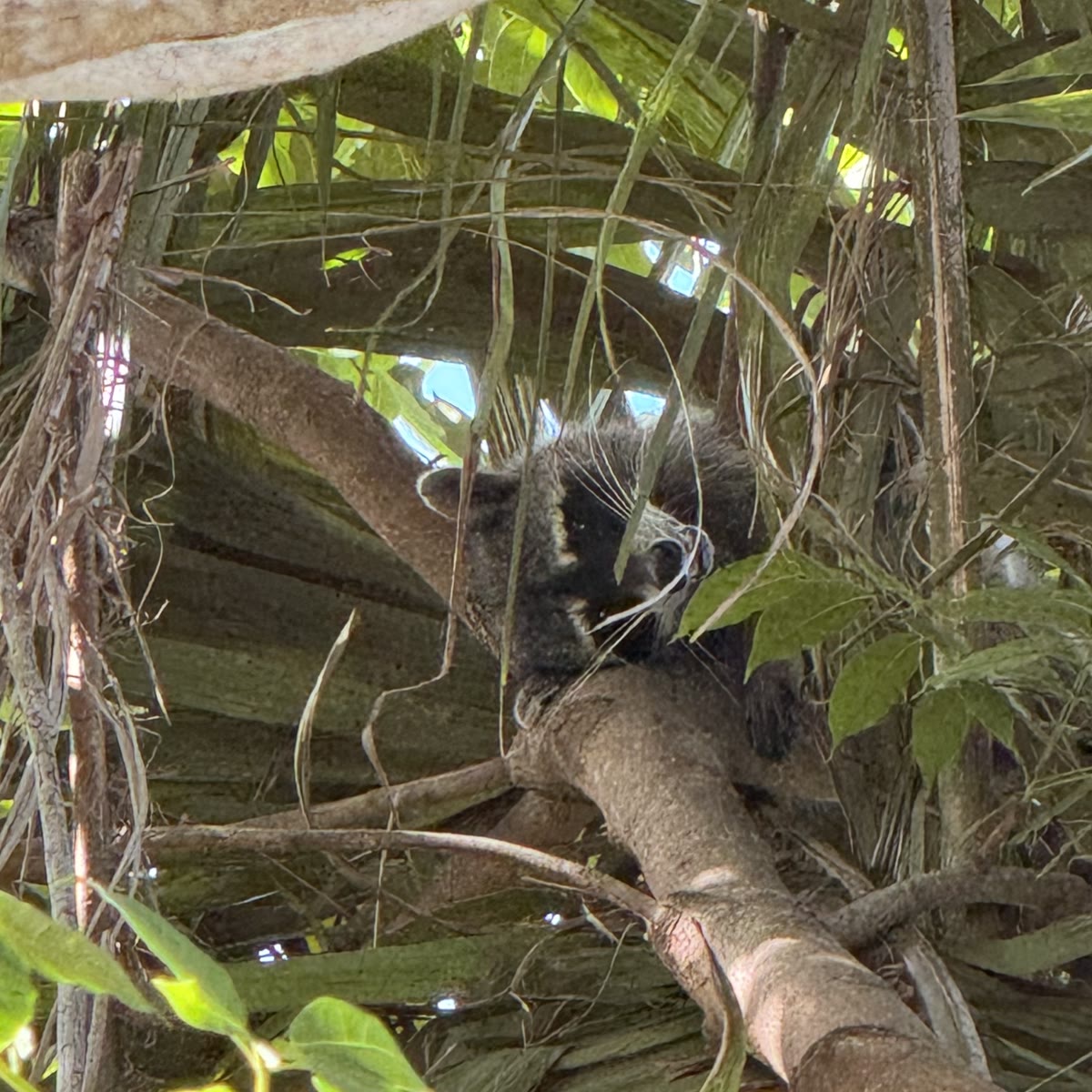
Never takes off his mask
Maestro Plo Koon
North American raccoon. Active at night, hidden by day.
See on StarWars.com ↗Tap the credential to flip it
The next to appear, again in the highest treetops, right above where the ostriches live, was a raccoon that spends the day almost motionless among the branches, hidden, waiting for nightfall to come down and get to work.
We named it Master Plo Koon — the only member of the Jedi Council who, like this raccoon, never takes off its mask. With Yoda in the garden and Qui-Gon Jinn in the neighboring tree, the Jedi Council is already forming on this land without anyone inviting them.
And the title of master, not padawan, is no coincidence: among procyonids, the raccoon has a well-deserved reputation for being clever and mischievous — able to open locks, lids, and basically anything that interests it, using those five-fingered hands almost like we do.
"The only member of the Jedi Council who, like this raccoon, never takes off his mask."
Given the black mask around its eyes, the tail with alternating dark and light stripes, and the dense grayish-brown fur, everything suggests that Master Plo Koon is a northern raccoon (Procyon lotor) — the most widespread procyonid in Mexico, present in all 32 states.
- It's mostly nocturnal, spending the day hiding in tree holes or foliage and coming out to forage at night.
- The black mask around its eyes is what sets it apart from any other Mexican mammal.
- It has five long, clawless fingers on each hand, with a sense of touch so fine it can identify objects almost without needing to see them.
- It's omnivorous, eating everything from fruits, nuts, and corn to insects, crabs, small birds, and eggs.
- It can weigh between 5 and 15 kilograms, with its tail making up to a quarter of its total length.
- Although it can live in groups, it's usually solitary, especially adult males.
- It's an arboreal species that can climb down a tree headfirst, rotating its ankles almost 180 degrees — something few climbing mammals can do.
- A close relative, the Cozumel raccoon (Procyon pygmaeus), is endemic to Cozumel Island, just a few kilometers from here on the Yucatan coast.
Friends of the house
El Padre, el Hijo y la Hija
Pavo cristatus
The latest to join the grounds: a family of peacocks that started strolling through the hallways as if the place had been theirs for years. With the Jedi Council already complete with ostriches, grasshopper, howler monkey, and raccoon, for this family we looked for something different — and we found it in the same universe, in a much less known corner: Mortis.
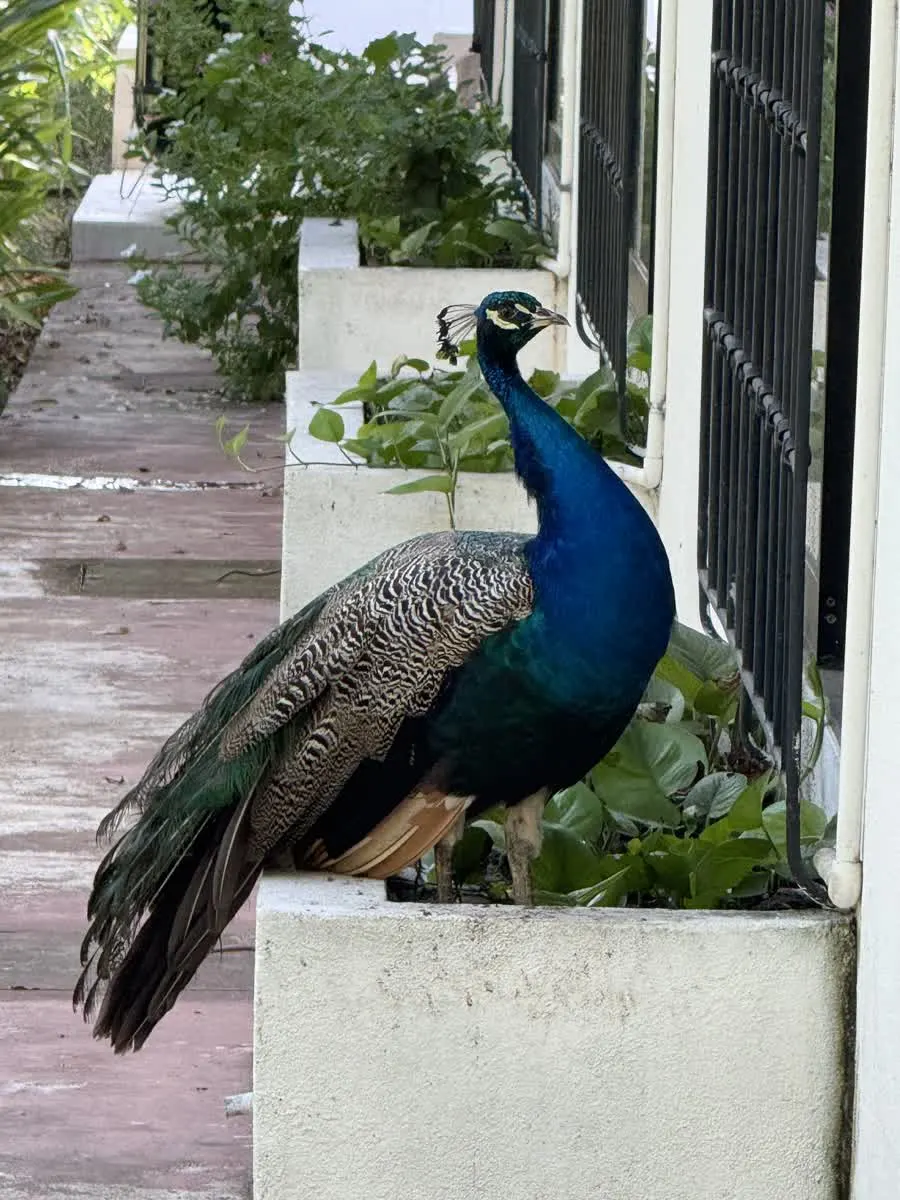
The one who holds balance
The Father
Male peacock. Mediates between the light and darkness of his two children.
See on StarWars.com ↗Tap the credential to flip it
Mortis is a hidden planet that appears in Star Wars: The Clone Wars, little known outside the most hardcore fandom. It's home to three human-like beings who are, literally, the embodiment of the Force: the Father, the Son, and the Daughter.
The Father is the one who maintains balance between his two children — the Son represents the dark side, the Daughter the light side — and who, feeling his powers waning, seeks someone capable of taking his place as mediator.
Here's the most striking of the three: the male with complete blue-green plumage, which he opens like a fan when he wants to show off.
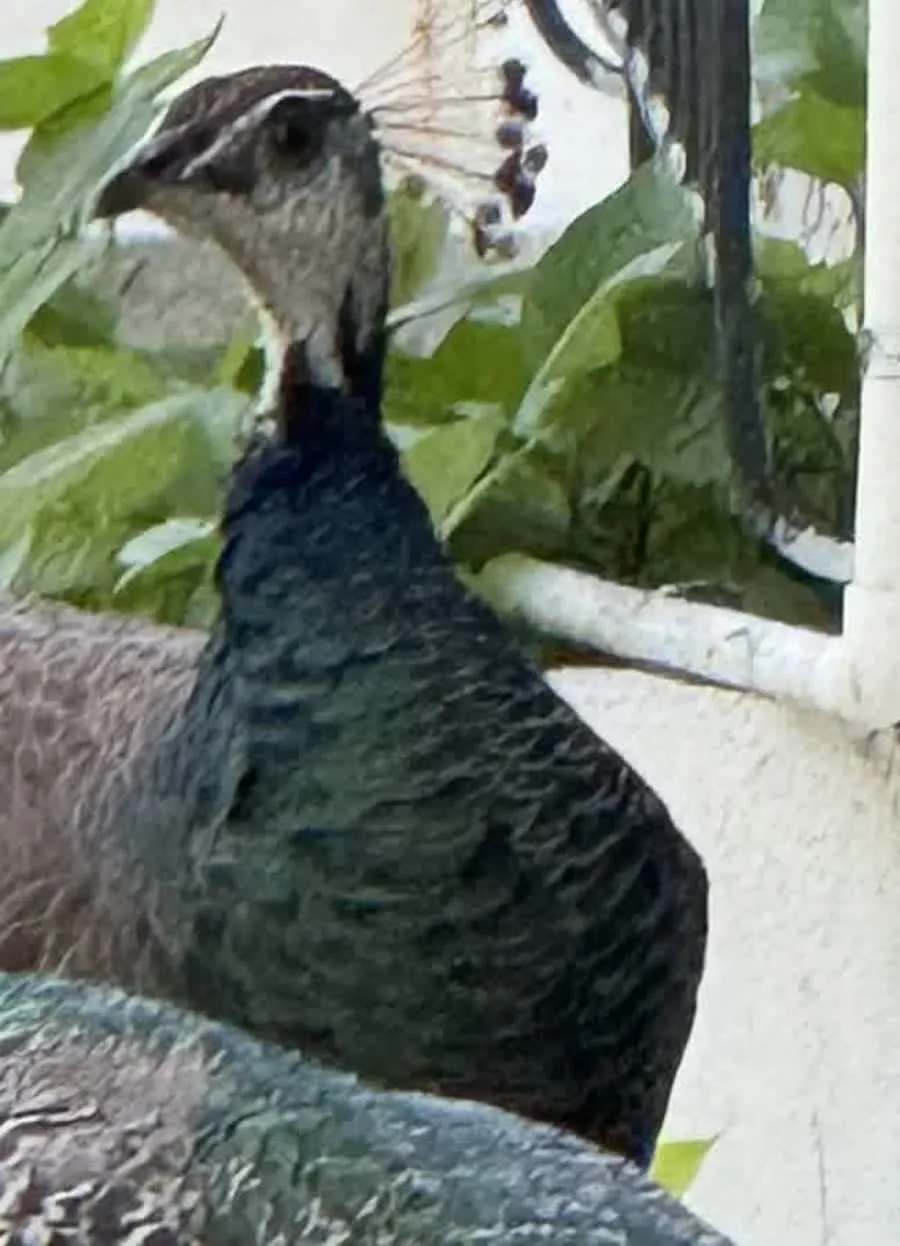
The light of the trio
The Daughter
Sacrifices herself for Ahsoka Tano. Her essence lives on in the owl Morai.
See on StarWars.com ↗Tap the credential to flip it
The Daughter represents the light side of the Force. In the Mortis arc, she sacrifices herself to save Ahsoka Tano from an attack by her brother — and in her final moments, her essence passes into Ahsoka herself.
Years later, that essence manifests as a spectral owl — known in the canon as Morai — that appears in the most important moments of Ahsoka's life, as if the Daughter were still watching over her from afar.
"Her essence remains linked to Ahsoka, manifested as an owl {{OWL}} that watches over her from a distance."
This owl has its own name in the canon: Morai See on StarWars.com ↗, a mystical and mysterious being of the Force. There's no photo of it here on purpose — every time we try to take one, it disappears just before the click.
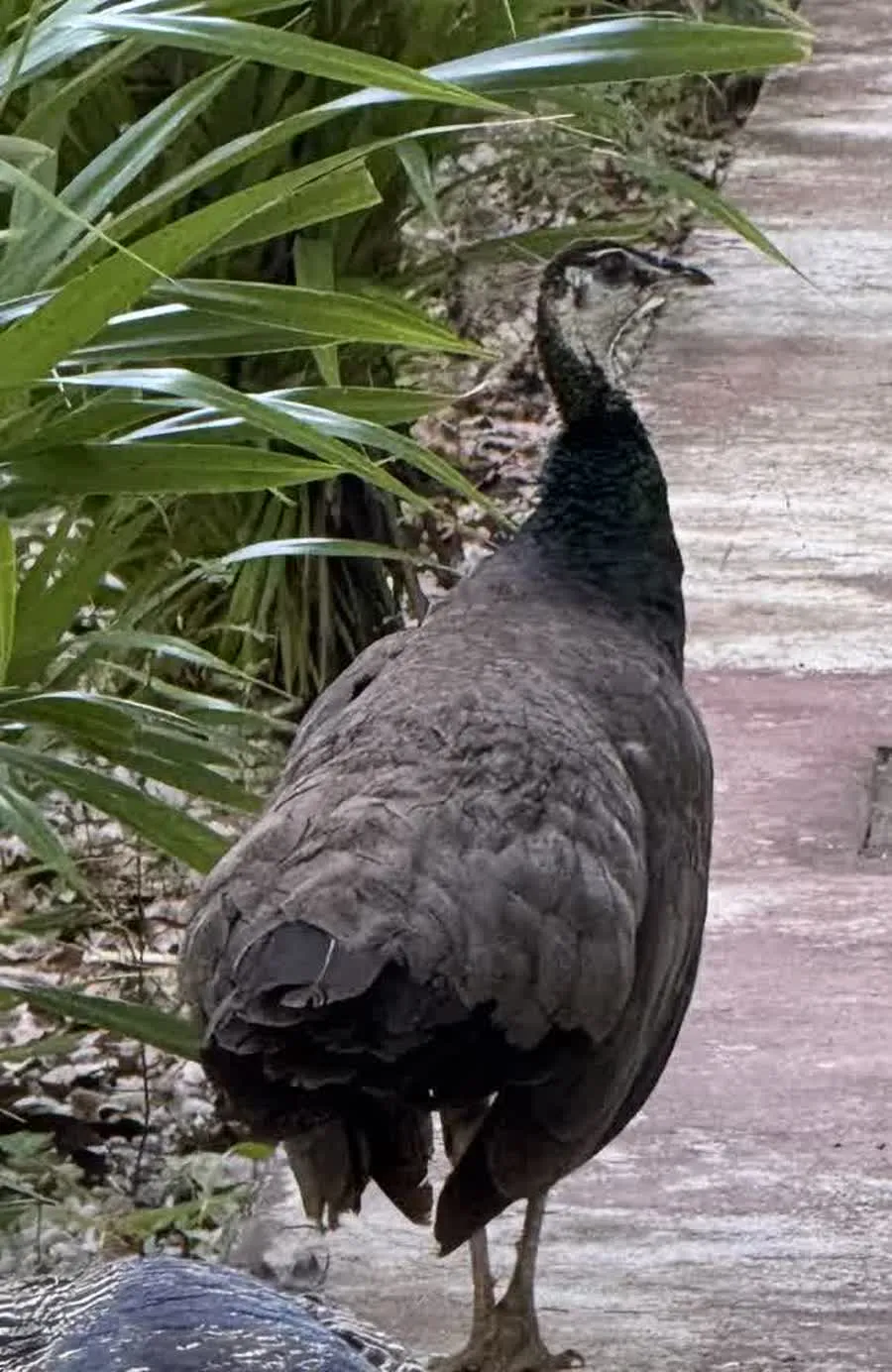
Here's the one that retains a hint of that same blue-green familiar color on her neck, although without the full plumage of the Father.
The dark side
The Son
The most discreet of the three — but in the original arc, the most dangerous.
See on StarWars.com ↗Tap the credential to flip it
The Son represents the dark side of the Force. He's the most aggressive of the three, and much of the Mortis arc revolves around his attempts to escape the balance his father imposes on him.
Here's the one with the most subdued brown tones, the most discreet of the three — the one who least stands out in the group, although in the original story he's the most dangerous of the three.
Given the metallic blue-green plumage of the male, the long tail of coverts that opens into a fan during courtship, and the much more discreet grayish-brown tone of the females, everything suggests that these are common peacocks or Indian peacocks (Pavo cristatus) — the most widespread ornamental species in Mexican gardens and estates.
- What looks like its tail isn't its real tail — they're extremely long supracaudal feathers (covert feathers) that grow over a much shorter tail, which it uses as support to open its famous fan.
- Only males have this ornamental plumage; females are much more discreet, in brown and gray tones.
- It's originally from the Indian subcontinent, but has become a common ornamental species in gardens and estates around the world, including Mexico.
- Despite its heavy-looking plumage, it can fly short distances — in fact, it usually sleeps in the highest branches of trees to protect itself from predators at night.
- Its song is extremely loud and can be heard over a kilometer away.
- It's omnivorous: it eats seeds, insects, and small reptiles — including venomous snakes, which it can hunt without a problem.
- It's the national bird of India.
35 facts about ostriches
- It's the largest living bird in the world. Barely lives up to the expectations I have for them.
- It can't fly — its wings are used for balance while running and in courtship. Basically decorative, like many boards of directors.
- It's the fastest land bird: it can run up to 70 km/h. Faster than any business proposal I've received this year.
- It can maintain around 50 km/h for long distances without getting tired. I wish my wifi had that kind of consistency.
- Each stride while running can be between 3 and 5 meters. With that stride, I'd have already walked to the office.
- It has only two toes per foot — the rest of the birds have three or four. Fewer toes, zero drama — something we could all learn from.
- Its kicks are so strong they can be lethal even for a lion. Take note: the real security guard of this house is already hired.
- It has the largest eyes of any land animal: about 5 centimeters in diameter. They see everything. Absolutely everything. Yes, even that time you left the door open.
- An ostrich's eye is literally bigger than its own brain. There are people posting on LinkedIn with that same proportion.
- It lays the largest eggs of any living bird. I wish I had a average ticket that big.
- An ostrich egg is equivalent to about 24 chicken eggs. For what my siblings eat, that doesn't even count as a start.
- The shell is so resistant that an adult can stand on it without breaking it. More resistant than any improvised business plan on a napkin.
- It's not true that they bury their heads in the sand — the myth comes from when they lower their heads to ground level to turn the eggs in the nest. So they don't avoid their problems either — another thing they surpass us at.
- It's native to the savannas and semi-arid areas of Africa. And yet they adapted to Méridacapital y ciudad más poblada del estado de Yucatán, México without complaining about the heat. What an example.
- It's omnivorous: it eats mostly plants, seeds, and grasses, but also insects and small reptiles. Eats whatever it finds, like me in a meeting that's gone on too long.
- Since it doesn't have teeth, it swallows pebbles (gastroliths) that help it grind food in its gizzard. A digestive system with more operational discipline than many startups.
- It can go several days without drinking water, getting moisture from the plants it eats. I'm a public danger without coffee after two hours.
- Its lifespan is 30 to 40 years — even more in captivity. So this is a long-term relationship, not an internship.
- It reaches sexual maturity between 2 and 4 years of age. They mature faster than some partners I've had.
- Adult males are mostly black with white feathers on their wings and tail; females are a grayish brown. The only dress code in this house that's actually respected.
- An adult male can weigh between 90 and 130 kilograms — some exceed 150. And yet they run faster than me on a Monday morning.
- It can measure up to 2.7 meters tall. Taller than I imagined when I said 'a couple of new pets'.
- Its long neck allows it to detect predators from very far away in the savanna. Also useful for seeing who arrived unannounced at the property.
- It has exceptional hearing and vision. They find out everything before the family WhatsApp group.
- It lives and moves in groups, usually between 5 and 50 individuals. Like a board meeting, but with better attendance.
- It's curious by nature: it investigates everything that moves near it. If they worked at Ignia Cloud, they'd already be on the QA team.
- It often shares territory with zebras and wildebeests, which take advantage of its good eyesight to detect danger. The interspecies networking that I have to work so hard to do.
- Its nest is just a hole in the sand, sometimes shared by several females from the same group. Less infrastructure than many startups in the seed stage, and yet it works.
- The dominant female usually lays her eggs right in the center of the nest, where they're best protected. I wish I had that clarity of hierarchy in a board meeting.
- Males usually take care of incubating the eggs at night. The only one in this house who does night shifts without complaining.
- It can run in zigzags to confuse a predator during a chase. The same technique I use to avoid unnecessary meetings.
- Its plumage, although it doesn't fly, helps regulate its temperature under the sun. Functional and stylish — something most sacks don't achieve.
- It's farmed in several countries — including Mexico — for its meat, skin, and feathers. A topic that {{AGE}} Luke and Leia prefer not to discuss at dinner, and {{OWL}} also avoids.
- An ostrich chick can grow up to 30 centimeters per month during its first year. At that speed, you'd better not blink — or buy bigger clothes every month.
- It can live perfectly in pairs or groups and recognizes those who care for it every day. And yet they still don't recognize who pays for their food — typical.
 Larry
Larry