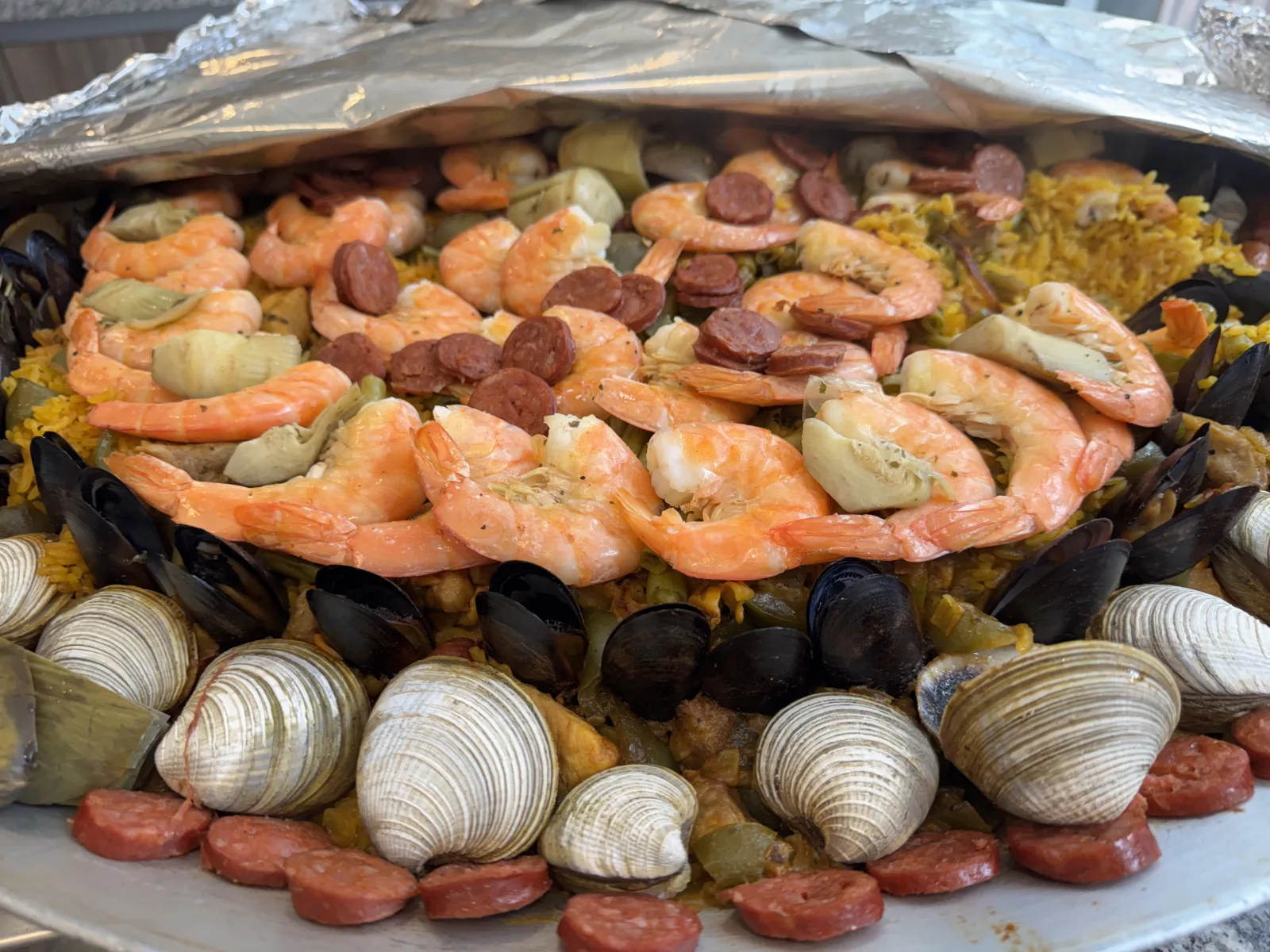
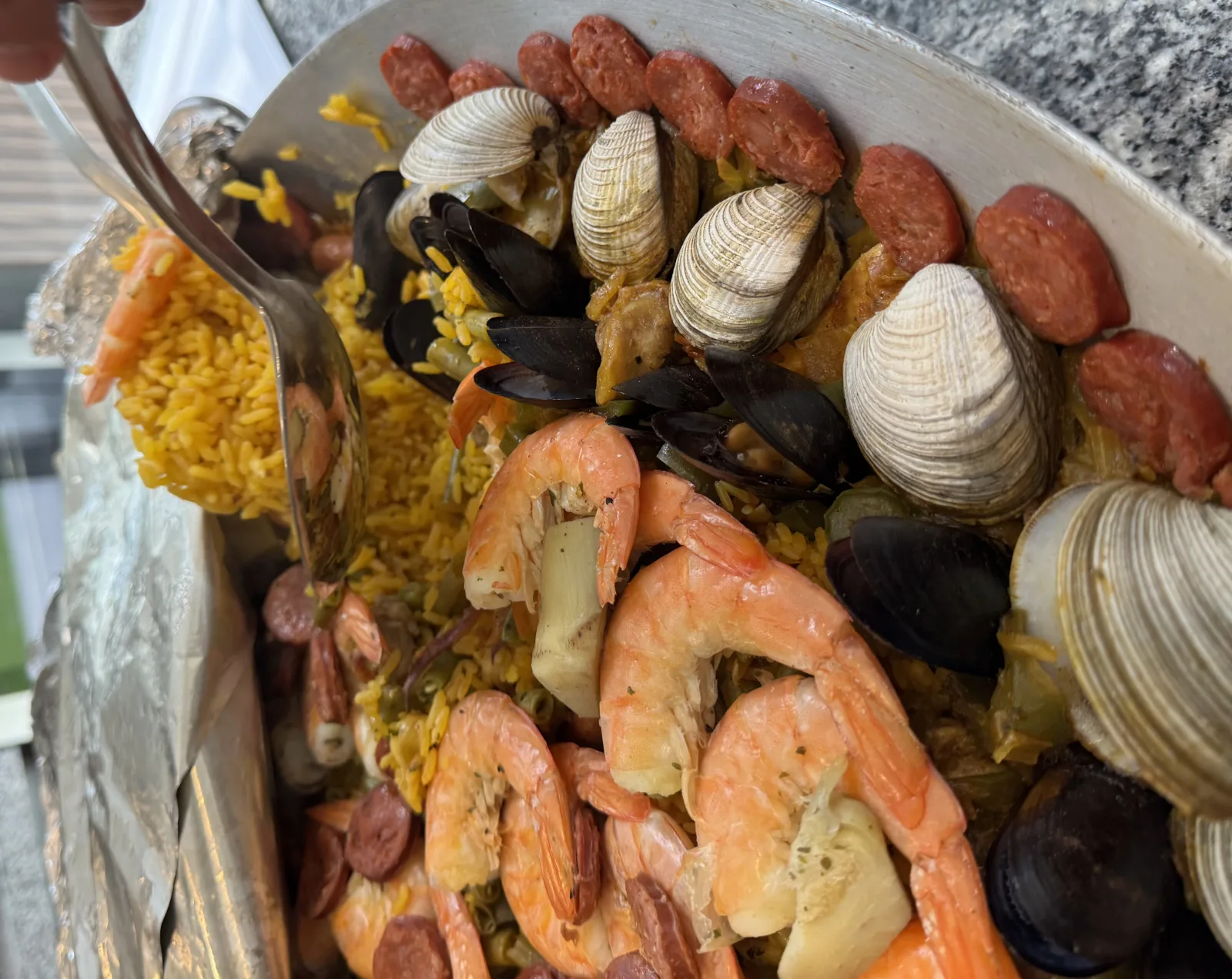
This paella marinera - shrimp, clams, mussels, chorizo, and artichoke on yellow rice - is one of those meals that demand silence at the table. It's served from the same container where it was cooked, in the center, and everyone takes what they can before it's gone. The one in the photo, because it has chorizo along with seafood, would be, strictly speaking, a homemade mixed paella, although nobody at the table stopped to discuss the classification.
And since we're here, a clarification that makes every orthodox Valencian proud, although the rest of the world ignores it happily: "paella" isn't, strictly speaking, the name of the dish - it's the name of the pan. It comes from the Latin patella ("small pan"), through the Valencian language, and refers to that wide, low pan with two handles where the rice is cooked. What's inside, speaking properly, is called arroz a la paella - "rice made in the paella", the same construction as "chicken on the grill" or "fish on the grill".
And what about the paellera? It depends on who you ask. In several Latin American countries, "paellera" is synonymous with the pan itself. But among families, "the paellera" is often not the object, but the person: the one in charge of the rice kitchen that Sunday. The curious thing is that in Valencia itself, making paella is traditionally an almost exclusively male ritual, outdoors and over wood - so the family paellera and the Valencian paellero of Sunday are, culturally, two quite different characters.
- "Paella" comes from the Latin patella (small pan) through the Valencian language - the name of the container, not the dish, which is strictly called arroz a la paella.
- Traditional Valencian paella has chicken, rabbit, garrofón, and green beans - no seafood, which is a later coastal variant and, for a Valencian purist, almost a heresy.
- The yellow color of the rice comes from saffron, the most expensive spice in the world by weight - although many domestic recipes stretch it, or substitute it altogether, with food coloring.
- The socarrat - the lightly toasted and crunchy rice layer that sticks to the bottom - isn't a cooking mistake: it's the most coveted result of all, and whoever gets it wins the meal.
- Paella is traditionally cooked over orange or vine wood fire, never on a stove - the smoke and dispersed heat of the wood are, according to Valencians, impossible to replicate in a normal kitchen.
Paella valenciana (the original)
The mother recipe, without seafood, from which all others come - and against which they're compared: chicken, rabbit, garrofón, and green beans.
Ingredientes: Arroz bomba, Chicken pieces, Rabbit pieces, Garrofón (or white beans), Flat green beans (ferraura), Grated tomato, Saffron, Sweet paprika, Olive oil, Water or broth.
- Sear the chicken and rabbit pieces in olive oil inside the paella until well browned.
- Add the green beans and garrofón, sear for a few more minutes.
- Add the grated tomato and paprika, cook until reduced.
- Add hot water or broth with saffron and salt; let simmer 15-20 minutes.
- Add the rice, distributing it evenly, without stirring afterwards.
- Cook over high heat 10 minutes and then low 8-10 minutes more, until the socarrat forms at the bottom.
- Let rest 5 minutes covered with a cloth before serving.
Paella de conejo (de monte)
A more rustic and "dry" version of the Valencian, with rabbit as the absolute protagonist - sometimes with snails.
Ingredientes: Arroz bomba, Rabbit pieces, Pork ribs (optional), Snails (optional), Green beans, Garrofón, Grated tomato, Garlic, Paprika, Fresh rosemary, Saffron, Olive oil.
- Brown the rabbit (and pork ribs, if used) in olive oil - it needs more searing time than chicken to be tender.
- Add the garlic, green beans, and garrofón; sear.
- Add the grated tomato and paprika, cook until thickened.
- Add the hot broth with saffron (and snails, if used); simmer 20 minutes for the rabbit to cook well.
- Add the rice, distribute evenly, and cook over high heat 10 minutes, then low 10 minutes more.
- Finish with fresh rosemary on top the last few minutes, and let rest 5 minutes before serving.
Paella de marisco
The coastal variant, without meat, starring seafood - the one almost everyone outside Spain imagines when thinking of "paella".
Ingredientes: Arroz bomba, Shrimp, Mussels, Clams, Squid rings, Red bell pepper, Garlic, Grated tomato, Saffron, Fish or seafood broth.
- Sear the whole shrimp briefly just to brown them, remove and reserve.
- In the same oil, sear the garlic, bell pepper, and squid.
- Add the grated tomato, cook until reduced.
- Add the hot fish broth with saffron, and let simmer.
- Add the rice, distribute evenly, and place the mussels and clams on top with the shell facing up, so they open with the steam.
- Cook over high heat 10 minutes and low 8-10 minutes more; return the shrimp the last 3-4 minutes.
- Let rest before serving.
Paella mixta
The one that mixes worlds - meat and seafood - that every Valencian purist condemns and that everyone else orders anyway. The one in the photos above is a close cousin of this one.
Ingredientes: Arroz bomba, Chicken pieces, Pork ribs or chorizo, Shrimp, Squid, Mussels, Green beans, Red bell pepper, Grated tomato, Saffron, Broth.
- Brown the chicken and pork ribs or chorizo in olive oil.
- Add the squid, bell pepper, and green beans; sear.
- Add the grated tomato and paprika, cook until thickened.
- Add the hot broth with saffron, simmer 15 minutes.
- Add the rice, distribute evenly, and place the shrimp and mussels on top.
- Cook over high heat 10 minutes and low 8-10 minutes more, until the socarrat forms.
- Let rest 5 minutes before serving.
Arroz negro (paella negra)
Dyed deep black with squid or cuttlefish ink - dramatic on the table and, with a bit of alioli on top, one of the most elegant of the whole family.
Ingredientes: Arroz bomba, Squid or cuttlefish pieces, Squid or cuttlefish ink, Garlic, Red bell pepper, Grated tomato, Fish broth, Alioli for serving.
- Sear the squid or cuttlefish in olive oil until browned.
- Add the garlic and bell pepper, sear.
- Add the grated tomato, cook until reduced.
- Add the hot fish broth dissolved with the squid ink, mixing well for a uniform color.
- Add the rice, distribute evenly, and cook over high heat 10 minutes and low 8-10 minutes more.
- Serve with a spoonful of alioli on top of each plate.
Arroz a banda
The rice of the fishermen of Alicante - the fish is cooked and served separately, and the rice, just with its broth, doesn't need anything else on top.
Ingredientes: Arroz bomba, Assorted rockfish (for the broth), Concentrated fish broth, Garlic, Grated tomato, Paprika, Saffron or food coloring, Alioli for accompaniment.
- Prepare a concentrated fish broth with rockfish, and reserve the cooked fish aside to serve as a second course.
- Sear garlic and grated tomato in olive oil inside the paella.
- Add the paprika and the hot fish broth with saffron.
- Add the rice, distribute evenly, and cook over high heat 10 minutes and low 8-10 minutes more.
- Serve the rice alone, as the main course, with the cooked fish aside and alioli for accompaniment.
Paella de bogavante (or langosta)
The luxury version - the whole lobster, cut into pieces with shell and all, looking like the undisputed star of the dish.
Ingredientes: Arroz bomba, Lobster pieces (with shell), Grated tomato, Garlic, Red bell pepper, Saffron, Fish broth.
- Briefly sear the lobster pieces in olive oil just to brown them on the outside, remove and reserve.
- In the same oil, sear the garlic and bell pepper.
- Add the grated tomato, cook until thickened.
- Add the hot fish broth with saffron, simmer.
- Add the rice, distribute evenly, and place the lobster pieces on top again.
- Cook over high heat 10 minutes and low 8-10 minutes more, and let rest before serving - the shell keeps releasing flavor until the last minute.
Paella de verduras (hortelana)
The vegetarian version, with the entire Valencian garden on top of the rice, without feeling like a sacrifice compared to the versions with meat.
Ingredientes: Arroz bomba, Artichoke, Green beans, Garrofón, Red bell pepper, Grated tomato, Garlic, Saffron, Vegetable broth.
- Sear the artichoke and bell pepper in olive oil.
- Add the green beans and garrofón, sear for a few more minutes.
- Add the grated tomato and garlic, cook until reduced.
- Add the hot vegetable broth with saffron, simmer 10 minutes.
- Add the rice, distribute evenly, and cook over high heat 10 minutes and low 8-10 minutes more.
- Let rest 5 minutes before serving.
Paella de pato
Less common, more intense - the duck adds a much deeper fat and flavor than chicken, especially with its confit legs.
Ingredientes: Arroz bomba, Duck legs (fresh or confit), Mushrooms, Green beans, Grated tomato, Garlic, Saffron, Duck or chicken broth.
- Brown the duck legs well in their own fat inside the paella.
- Add the mushrooms and green beans, sear.
- Add the grated tomato and garlic, cook until thickened.
- Add the hot broth with saffron, simmer 15-20 minutes for the duck to be tender.
- Add the rice, distribute evenly, and cook over high heat 10 minutes and low 8-10 minutes more.
- Let rest before serving.
Arroz al horno (Alicante style)
Not made in the traditional paella pan, but in the oven, in a clay pot - with pork ribs, chickpeas, and blood sausage, one of the most robust versions of the whole family.
Ingredientes: Arroz bomba, Pork ribs, Blood sausage, Cooked chickpeas, Whole garlic head, Grated tomato, Paprika, Broth.
- Brown the pork ribs and blood sausage in a clay pot on the stovetop.
- Add the grated tomato and paprika, cook for a few minutes.
- Add the hot broth, cooked chickpeas, and rice; distribute evenly.
- Place the whole garlic head in the center, on top of everything.
- Put the pot in a preheated oven at 200°C for 20-25 minutes, without covering, until the rice absorbs the liquid and the surface browns.
- Let rest 5 minutes before serving directly from the pot.
Arroz meloso (or caldoso) de marisco
The creamy cousin of paella - same spirit, more broth, texture almost like risotto instead of the loose, dry grain of classic paella.
Ingredientes: Arroz bomba or senia, Shrimp, Squid, Mussels, Garlic, Grated tomato, Paprika, Saffron, Fish broth (more than in a normal paella).
- Sear the garlic and squid in olive oil.
- Add the grated tomato and paprika, cook until reduced.
- Add the hot fish broth with saffron, using more than usual - the result should be juicy, not dry.
- Add the rice and cook over medium heat, stirring occasionally (unlike dry paella, you can move it here).
- Add the shrimp and mussels the last 5 minutes of cooking.
- Serve immediately in a deep plate, with a spoon - this one isn't left to rest, it's eaten brothy.

 Larry
Larry