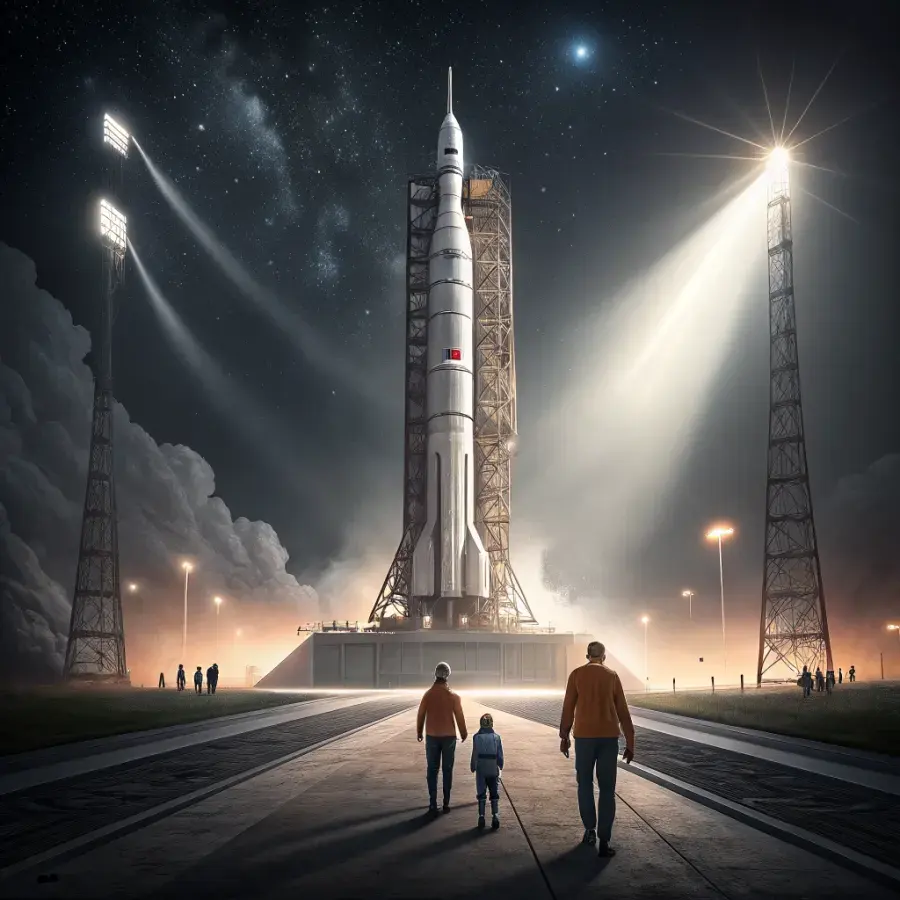
While the World Scrolls, a Giant Moves: Artemis II and the Path to Mars
2026-01-20 · By Esteban Rey (@Kilowatto) · 8,113 reads
Narrado con la voz sintética de Larry. El texto es de Esteban; la voz no es humana. Read the transcript.
We live in an era of attention deficit. Between the latest political scandal, stock market fluctuations, and the relentless noise of social media, we often let the events that will truly define the future of our species slip by. We are so busy looking down at our screens that we forget to look up.
This past Saturday, while the news cycle shredded the ephemeral, something historic happened at Cape Canaveral. In an operation that lasted nearly 12 hours, a colossus of metal and technology moved agonizingly slowly toward Launch Pad 39B.
It is the rocket for the Artemis II mission. And although its journey was just a few miles atop NASA’s legendary crawler-transporter, that rollout symbolizes that humanity's return to the Moon has moved from a PowerPoint presentation to real, vertical hardware ready for a countdown.
SLS and Orion: The Interplanetary Uber
To understand why this matters, you have to understand what we are looking at. This isn't just another commercial rocket sending satellites into low orbit.
What moved this weekend is the SLS (Space Launch System), the most powerful rocket NASA has ever built. Unlike commercial rockets, the SLS is designed with one brutal purpose: to generate the raw force needed to break the chains of Earth's gravity and push heavy payloads into deep space.
At the tip of that spear rides the Orion spacecraft. If the SLS is the muscle, Orion is the shield and the brain. It is the capsule designed to keep four astronauts alive in the most hostile environment imaginable, far beyond Earth's magnetic protection, where radiation is lethal and the margin for error is zero.
And this time, Uncle Sam isn't going alone. Unlike the Apollo era, this is an integrated multinational effort. The service module that powers, propels, and provides life support to Orion isn't American; it is the work of the European Space Agency (ESA). Likewise, the Canadian Space Agency (CSA) is a critical partner that has already secured a seat for one of its astronauts (Jeremy Hansen) on this mission. It is the validation that the 21st-century space frontier is conquered in coalition, not in solitude.
Beyond the Footprint: Mining and Compute
I recently wrote in this space about the concept of the "Over Cloud" and orbital data centers. I spoke of servers in space powered by infinite solar energy. Many saw it as distant science fiction.

But missions like Artemis II are the foundation of that reality. We are not returning to the Moon out of 1960s nostalgia, nor just to plant another flag. The strategic objective is to stay.
The Moon is our mandatory sandbox. If we dream of reaching Mars, we first have to learn how to live on the Moon. If we dream of space mining—extracting Helium-3 for nuclear fusion or rare earths from asteroids—we need a service station in lunar orbit. The Moon is not the final destination; it is the port of departure for the solar system.
Without Artemis, there is no lunar base. Without a lunar base, there is no asteroid mining. And without space mining, Earth's economy will remain limited by the finite resources of our crust.
Windows of Opportunity (and Physics)
Although seeing the rocket on the pad is thrilling, the reality is that challenges remain. The Artemis II mission will not land; it will be a crewed flyby (similar to Apollo 8) to prove that humans can survive the journey in Orion.
And here enters the coldness of astrophysics. We cannot launch whenever we want. NASA has not given an exact date, but a calendar of "launch windows."
Unlike a flight to New York, going to the Moon requires a perfect alignment of orbital mechanics: the position of Earth, the location of the Moon, and the rocket's capacity must synchronize to ensure not only the outbound trip but a safe return and adequate solar lighting for Orion's panels. These windows open and close for days or weeks. Missing a window means waiting for the cosmic waltz to align again.
Saturday's rollout was a physical and tangible reminder. While we argue about the day-to-day grind, thousands of engineers—American, European, and Canadian—are moving, inch by inch, the machinery that will finally make us a multi-planetary species.
It is worth looking up from the screen for a moment to see it.
 Larry
Larry
Comments
Be the first to comment.