Dr. GPT Will See You Now: Why "AI Triage" Should Be Public Policy, Not a Guilty Secret
2026-01-10 · By Esteban Rey (@Kilowatto) · 8,732 reads
Narrado con la voz sintética de Larry. El texto es de Esteban; la voz no es humana. Read the transcript.
While the medical elite marvels at Artificial Intelligence’s ability to detect pancreatic cancer or fold proteins in record time, a much quieter, yet massive revolution is happening on the streets—or rather, on the screens. Millions of Americans have graduated from "Dr. Google" and WebMD anxiety spirals; they are now having full-blown consultations with chatbots.
Whether via ChatGPT , Claude, or AI at Meta , the average user is turning the chatbot into their de facto primary care physician for everyday ailments. "I ate spicy wings and my chest burns, what should I take?", "My toddler has a runny nose but no fever, is it allergies?".
The knee-jerk reaction from the American Medical Association Foundation (AMA) and regulators is rejection: "AI hallucinates," "it’s dangerous," "it encourages self-medication." And they are right about the risks. However, denying this reality is like trying to hold back the tide with a broom. The phenomenon is here, it is scaling, and it is unstoppable.
The Elephant in the Waiting Room
Let’s be blunt: prohibition doesn't work. Even if ethical companies like OpenAI or Google place "guardrails" to prevent prescribing controlled substances, the open-source ecosystem and models hosted in jurisdictions with different values will ensure there is always an AI willing to answer. We cannot legislate to ban the algorithm, but we can legislate to channel it.
I propose we stop viewing this as a threat and start seeing it as a public health tool to solve a chronic American crisis: the collapse of primary care access.
The United States is facing a breaking point. The American Association of Veterinary Medical Colleges (AAMC) projects a shortage of up to 86,000 physicians by 2036. In rural "medical deserts," the situation is already dire. Even in wealthy suburbs, getting an appointment with a General Practitioner can take weeks, and a visit to an Urgent Care for a simple sore throat can result in a $200 bill—even with insurance.
A massive volume of these medical interactions are "low complexity": common colds, mild indigestion, tension headaches. Cases that are historically resolved with rest, hydration, and Over-The-Counter (OTC) medications like ibuprofen or omeprazole.
A National Digital Triage
What if the FDA or the CDC, instead of fighting the current, certified or developed a standard for "AI-Assisted National Triage"?
Imagine a system validated by health authorities that allows citizens to query minor symptoms. An AI that doesn’t "hallucinate," but is strictly bounded by medical protocols to suggest OTC medications in an orderly fashion, with correct dosages and clear "red flags."
If the AI detects symptoms of something serious—appendicitis, heart attack, severe dehydration—it immediately directs the user to the ER or 911. But if it’s just heartburn, it suggests the right antacid, saving the patient a co-pay and freeing up a slot in the clinic for someone who is actually dying.
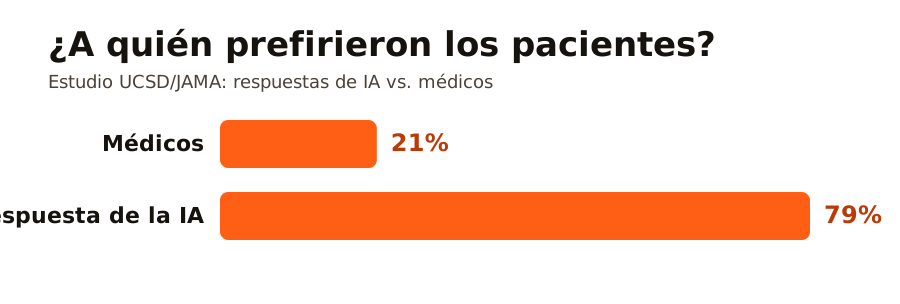
This isn’t science fiction. A study by the University of California San Diego (UCSD) published in JAMA Internal Medicine compared responses from physicians and ChatGPT to patient questions. Shockingly, evaluators preferred the AI's response 79% of the time, rating it not only as accurate but more empathetic and detailed than busy doctors rushing through 15-minute slots.
The Opportunity for the Coming Decade
The risk of doing nothing is that people will use unregulated, "jailbroken" models and end up taking dangerous advice. The risk of doing it right is... solving the bottleneck of frontline healthcare.
The "MinuteClinics" at CVS or Walgreens were a physical patch for this problem. AI on your smartphone is the logical digital evolution.
We need lawmakers to craft public policy for "AI-Assisted Self-Care for Minor Ailments." We need official databases, digital "seals of approval" for medical algorithms, and public education so the population knows when to trust the bot and when to run to the hospital.
Technology will never replace the warmth of a family doctor. But when that doctor is fully booked for three weeks, or out of network, or simply too expensive, a well-trained AI that tells you: "Take acetaminophen every 6 hours and stay hydrated," isn't a technological dystopia. For millions of Americans, it is the only path to immediate, dignified, and affordable health guidance.
 Larry
Larry
Comments
Be the first to comment.