AI is real, the NVIDIA bubble isn't: The dragon has already awakened
2025-12-18 · By Esteban Rey (@Kilowatto) · 4,058 reads
Narrado con la voz sintética de Larry. El texto es de Esteban; la voz no es humana. Read the transcript.
No one doubts that Artificial Intelligence is the most radical technological change since the birth of the Internet. It's a real, powerful, and transformative wave. But there's a huge difference between a technological revolution and a rational market valuation. Today, looking at the market capitalization of companies like NVIDIA, I couldn't help but feel a déjà vu of 1999. The market is pricing a future where these companies maintain an eternal monopoly and infinite margins.
And that's a dangerous fantasy.
The bullish thesis on Wall Street is based on one premise: "No one can catch up to NVIDIA. Their hardware is unbeatable." But if we look to the east, across the Pacific, we'll see that this competitive advantage isn't technological, but legislative. The only reason NVIDIA still reigns unopposed is the artificial wall of sanctions that the US government has built. But as history teaches us, walls don't stop innovation; they just divert it and often accelerate it.
The Chinese "Manhattan Project" effect
In 2022, when Washington banned the sale of H100 and A100 chips to China, the intention was to strangle the development of AI in the Asian giant. The result was exactly the opposite: it triggered a "Manhattan Project" for semiconductors. By closing the door to NVIDIA, they forced China to build its own house. And they've built it fast.
The technical data is overwhelming and disproves the narrative that China is "years behind":
- Huawei is back: Their new Ascend 910C chip (slated for mass production in 2025) is no longer a toy. It achieves performance comparable to NVIDIA's H100 thanks to an ingenious chiplet and massive cluster architecture. Huawei has already demonstrated Atlas clusters capable of training gigantic models, and giants like iFlytek and Baidu are already migrating.
- Hardware sovereignty: Companies like MetaX (founded by former AMD engineers) have launched the C600 GPU, with 144 GB of HBM3e memory — a figure that rivals and even surpasses NVIDIA's H200 in memory capacity. And what's most alarming for Silicon Valley: they claim it's 100% domestically produced.
- The end of CUDA dependence: NVIDIA's great "moat" was always its CUDA software. But necessity is the mother of invention. China has created a massive alliance where Huawei (CANN), Cambricon (NeuWare), and Moore Threads (MUSA) are building a unified ecosystem. MetaX has even made its chips compatible with CUDA, allowing developers to migrate their code almost painlessly.
The fragility of the American giant
NVIDIA is the king today, no doubt. But its crown is held up by trade blockages, not by an insurmountable technical superiority in the long term.
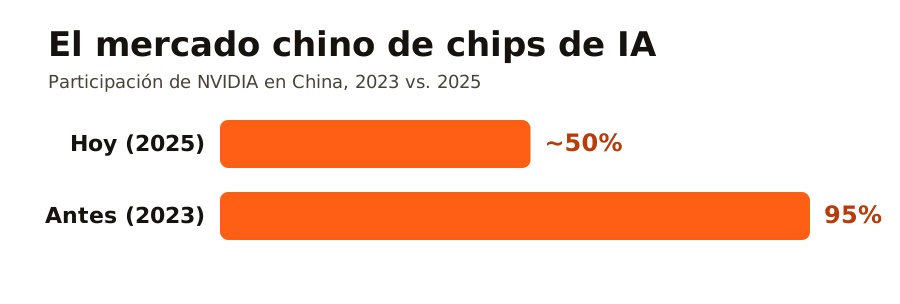
Analysts celebrate that NVIDIA sells "cut-down" chips (like the H20) to China, but they ignore that NVIDIA's market share in that country has gone from 95% to around 50% in 2025. That other 50% hasn't evaporated; it's been captured by Huawei, Alibaba, and Cambricon.
We're seeing the birth of a parallel ecosystem. While American companies depend on vulnerable global supply chains, China is achieving self-sufficiency across the entire stack: from design (Biren, MetaX) to manufacturing (SMIC) and cloud deployment (Alibaba Cloud, Baidu).
The unsustainable bubble
This is where the bubble comes in. Current valuations of AI hardware companies assume they'll keep selling shovels at gold prices forever. They don't discount the scenario — already visible — where AMD (which is also coming on strong) and Chinese manufacturers flood the market with "good enough" options at a fraction of the cost.
If the only salvation for American companies is the White House's blockages, then they don't have a solid business; they have a political protectorate. And protectorates don't last forever.
The Chinese AI market has already proven it can live without NVIDIA. What will happen when those Chinese chips, currently confined to their local market out of necessity, start looking at emerging markets in Asia, Africa, or Latin America?
AI isn't a bubble, but the belief that a single American company will own global intelligence is. Investors should look less at stock charts and more at the spec sheets coming out of Shenzhen and Shanghai. The monopoly is breaking, and the noise from the bubble bursting could be deafening.
 Larry
Larry
Comments
Be the first to comment.