
The Internet is "Too Big to Fail": The Dangerous Comfort of Centralization
2026-01-23 · By Esteban Rey (@Kilowatto) · 7,529 reads
Narrado con la voz sintética de Larry. El texto es de Esteban; la voz no es humana. Read the transcript.
Yesterday, the corporate world held its breath once again. A massive Microsoft 365 outage left thousands of companies and millions of users staring at error screens instead of working.
It wasn’t just about not being able to send an email or co-author an Excel sheet. The impact was far deeper and revealed our systemic fragility: Microsoft Teams, which today functions as the de facto PBX for countless organizations, left contact centers dead silent. Support lines were cut. Even more critically, the failure in email delivery systems prevented millions of users from receiving One-Time Passwords (OTPs).
Suddenly, you couldn’t log into your bank, you couldn’t validate a movie ticket purchase, you couldn’t sign documents. All because a single company, somewhere in "the cloud," had a bad day.
The "No-Brainer" Trap
I have spoken many times in this space about the risks of technological concentration, but incidents like yesterday’s force us to be more vocal.
Most people are unaware that the Internet—a network born with the promise of being decentralized and indestructible—now hangs by four or five very thick threads. And I don’t blame them. For Chief Technology Officers (CTOs) and consultants like myself, choosing these giants has been, for years, an obvious choice; a no-brainer.
I myself have migrated hundreds of domains to Cloudflare, set up thousands of mailboxes on Google Workspace and Microsoft 365, and deployed critical infrastructure on AWS. Why? Because they are cheap, innovative, and, most of the time, they work incredibly well. They are unbeatable allies of efficiency.
The Private Cloud Illusion
The problem arises when we believe we can isolate ourselves from the risk. I’ve heard many colleagues say: "That’s why I have my own private cloud, so I don’t depend on anyone."
I hate to burst that bubble, but it’s an illusion. Even if you have your servers in your own basement, it is highly likely that your system consumes third-party APIs, uses public DNS, or requires libraries that depend on this concentrated infrastructure.
If Cloudflare goes down, half of the applications your "private cloud" needs to talk to the outside world will stop responding. If AWS has a failure in the us-east-1 region, authentication services, payment gateways, or logistics systems you rely on will stop working. When these giants sneeze, your system—no matter how private—catches pneumonia. It is a systemic, invisible, and terrifying dependency.
The Lords of the Cable
To size up the problem, let’s look at who really holds up 99.99% of the Internet:
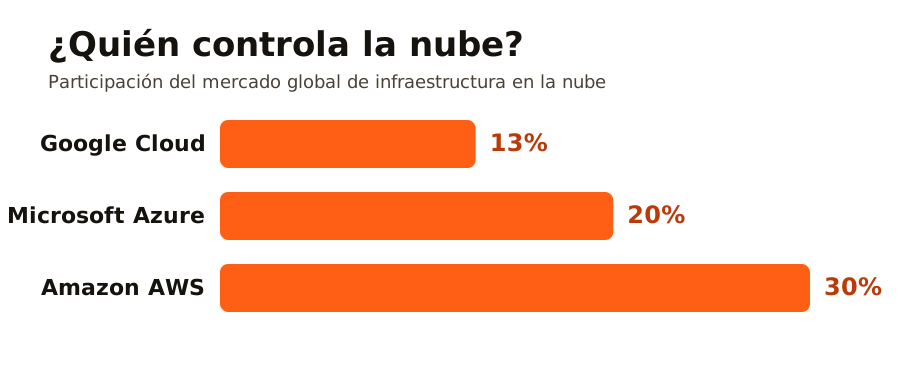
- The Cloud (Infrastructure): Just three companies (Amazon AWS, Microsoft Azure, and Google Cloud) control about 67% of the entire global cloud infrastructure market. If we add Alibaba, the figure exceeds 75%. The rest of the world fights for the crumbs.
- Web Traffic (CDN & Security): Cloudflare has become the doorman of the Internet. About 20% of all websites in the world and nearly 80% of those using a Content Delivery Network (CDN) depend on them. If Cloudflare unplugs a cable, a fifth of the web instantly vanishes.
- The Backbone (Tier 1 ISPs): Behind the clouds are the carriers. Companies like Cogent, Lumen (formerly CenturyLink), and Telia own the main highways. There are very few of them. When one fails (as happened with Cogent a few years ago), global routing breaks, and entire countries suffer latency or disconnection.
Public Policy or Strategic Diversification?
Yesterday's Microsoft blackout is a reminder that we have put all the eggs of the digital economy into very few baskets.
This brings us to an urgent crossroads. Should we start discussing a global antitrust public policy to avoid this systemic concentration and force a return to the Internet’s original, distributed architecture? That is a difficult and politically complex path.
Or, does the solution lie in the hands of tech decision-makers? Perhaps the time has come to stop blindly consuming the "number one" by default. Maybe the real resilience strategy for 2026 is to bet on provider number 3, 4, or 5. To look toward regional data centers, to bet on niche cloud providers that, while they may not have a thousand features, offer sovereignty and diversification.
Continuing to feed the giants is comfortable and cheap, until one random Tuesday, a failed update in Redmond or Northern Virginia flips the switch on your business, and you realize the control was never yours.
 Larry
Larry
Comments
Be the first to comment.