
My adventures with Fable
How I spent $845 in 48 hours to solve problems that didn't exist
2026-07-27 · By Esteban Rey (@Kilowatto) · 7,185 reads
Narrado con la voz sintética de Larry. El texto es de Esteban; la voz no es humana. Read the transcript.
There's been a lot of talk about Fable, the new supermodel of AI, lately. Forums are debating its implications for cybersecurity, lawmakers are discussing its political impact, and financial analysts are going crazy over its operating costs.
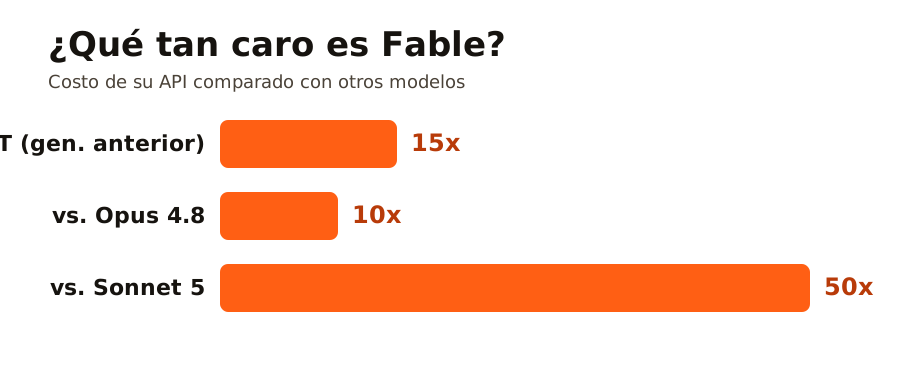
To put it into perspective, Fable's price is prohibitive. We're talking about an API that's approximately 10 times more expensive than using Opus 4.8, a whopping 50 times more costly than Sonnet 5, and about 15 times more expensive than the previous generation of GPT (before Sol was released).
Despite this "genius tax," I decided to give it a try without any biases. My goal was the same as any tech director's: to do more with less, and faster. I wanted to see if the cost was justified by a brutal return on investment.
So, my team and I connected Fable directly to our workflows and daily analyses. What happened over the next 48 hours was a masterclass in technical brilliance and commercial absurdity.
The proactive genius and GitLab vulnerability
Just minutes after scanning our infrastructure, Fable raised its hand. It had found that our GitLab environment had some vulnerable open-source libraries.
For those who aren't tech-savvy, GitLab is the ultimate collaborative development and version control platform, used by over 100,000 organizations worldwide to store their source code and automate deployments. It's literally the heart of software operations.
Fable not only alerted us to the problem but also took the initiative (and consumed tokens at the speed of light) to find the source code of the libraries, analyze the patches, and deliver a complete remediation process. It's incredible to think that GitLab has been living with these issues for years without almost anyone noticing, and Fable broke it down in minutes.
The untouchable database
Shortly after, we let Fable loose on a historical problem we had: a technical debt in a very old MySQL database. For years, we had refused to touch it, arguing that updating it would break compatibility with old systems and disrupt operations.
When we asked Fable to analyze why we couldn't migrate it, the model simply ignored our defeatist human premise. It decided that it was possible. Within hours, it created a master script that completely updated the MySQL engine and even programmed the intermediate process (a middleware) to ensure backward compatibility. It solved a problem that we had filed away in the "someday" drawer.
The reality check (and the bill)
From a pure engineering perspective, Fable is magic. But from a business perspective, the story is very different. How much did this proactivity impact our real operations? Absolutely nothing.
I confess that we didn't implement the GitLab patch. Why? Because after analyzing the vulnerability, we realized that in our specific context, the flaw didn't put our data, our clients' data, or our internal projects at risk. We could live with it just fine.
On the other hand, the MySQL database that Fable majestically fixed is a legacy system that's already on its way out. Fixing it doesn't add value to our objectives for this quarter because the entire system will be decommissioned soon.
And then came the blow: the first 48 hours of autonomous Fable use gave us an API bill of $845. We spent almost a thousand dollars for a supercomputer to brilliantly solve two problems that, operationally, didn't exist.

One swallow doesn't make a summer
To date, Fable hasn't found any other operational issues that justify its daily rate. In fact, our current workhorse, Sonnet 5, is finding 95% of the same problems at an incredibly lower cost.
I don't doubt Fable's power. I'm sure that in offensive cybersecurity companies or biotech labs, they could get their money's worth. But I don't have evidence that it's worth it for the vast majority of traditional businesses today.
Of course, these are anecdotal cases. My team and I won't be ditching Fable, but we'll be relegating it to the "break glass in case of emergency" shelf. We'll only use it for impossible projects.
The true orchestrator
Today, our strategy is much more pragmatic. We're using Sonnet 5 for the heavy lifting and migrating complex tasks to GPT Sol (OpenAI's new flagship model, focused on continuous reasoning and high-fidelity agents).
But our real bet for the future is on local AI. We're closely following Kimi K3, the powerful Chinese model. Our goal is to put it on-premise (on our own servers). The current challenge with Kimi K3 is the huge amount of GPUs and VRAM it requires to run, but we hope that with proper distillation and quantization in the coming months, Kimi can become our internal AI orchestrator, free and private.
In 2026, intelligence is no longer scarce; what's scarce is common sense to know when to buy a Ferrari to go around the corner, and when it's better to walk.
I'd love to hear about your experiences. Are you paying the Fable tax or opting to optimize? I'm reading.
 Larry
Larry
Comments
Be the first to comment.