From the Cloud to Orbit: When Earth Runs Out of Power
2025-12-19 · By Esteban Rey (@Kilowatto) · 6,076 reads
Narrado con la voz sintética de Larry. El texto es de Esteban; la voz no es humana. Read the transcript.
For two decades, we've been living under a misleading metaphor. We call it the "Cloud," but it's actually a deeply terrestrial infrastructure: thousands of acres of concrete warehouses, underwater copper and fiber cables, and above all, a voracious dependence on local power grids. But this terrestrial Cloud is reaching its limits. Between the thirst for water to cool and the hunger for gigawatts of Artificial Intelligence, the Earth is getting too small for us.
We're on the cusp of a new era: the birth of the "Over Cloud" or Orbital Computing. And it's not science fiction; it's a thermodynamic and economic necessity that we'll see take off (literally) between 2025 and 2035.
The Ultimate Energy Arbitrage
The reason to take servers to space isn't romanticism about exploration; it's pure financial math. On Earth, a data center struggles with intermittency: it's nighttime, it's cloudy, or the grid in Virginia or Querétaro is saturated.
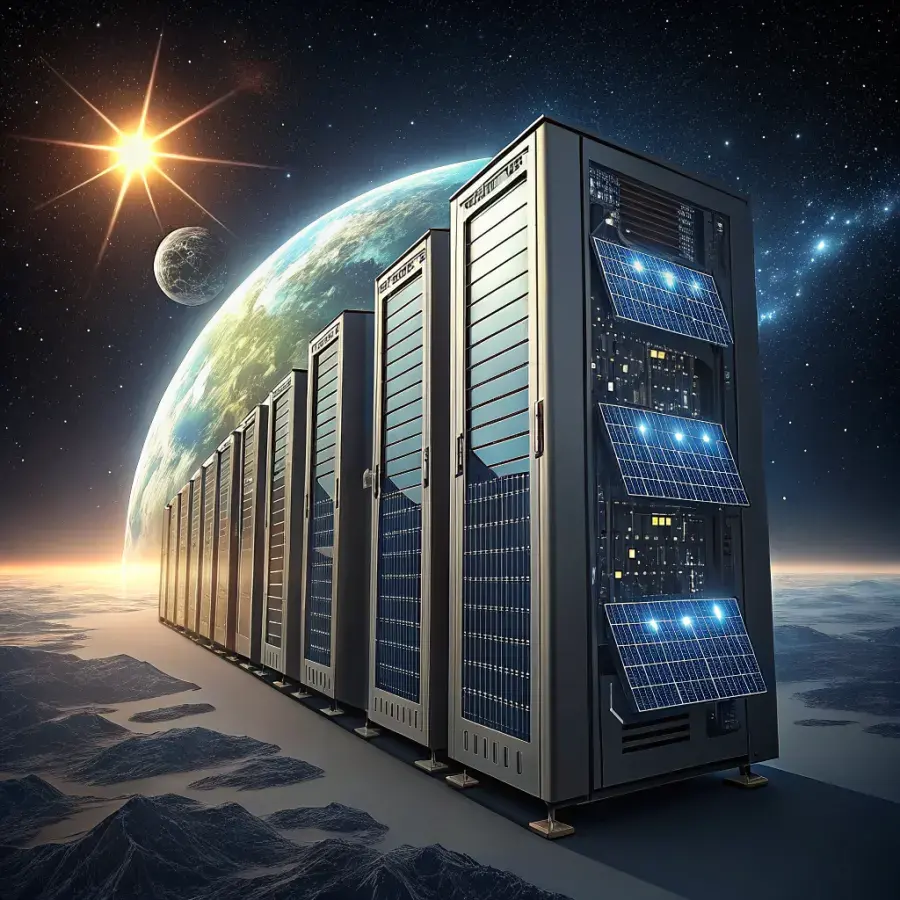
In low Earth orbit, above the real clouds, the sun never turns off. An orbital data center can access high-intensity solar energy 24/7. It's the dream of any hyperscale engineer: clean, constant, and infinite energy, without fighting for municipal permits or connections to the national power grid. Companies like Starcloud (formerly Lumen Orbit) and projects like Google's Suncatcher are already doing the math to put NVIDIA H100-class hardware into orbit.
However, if energy is the carrot, physics is the stick.
The Paradox of Cold and Thermal Hell
There's a popular myth that space is "cold," so cooling servers should be easy. Nothing could be further from the truth. On Earth, we use air or water to dissipate heat (convection). In the vacuum of space, there's no air. The heat has nowhere to go.
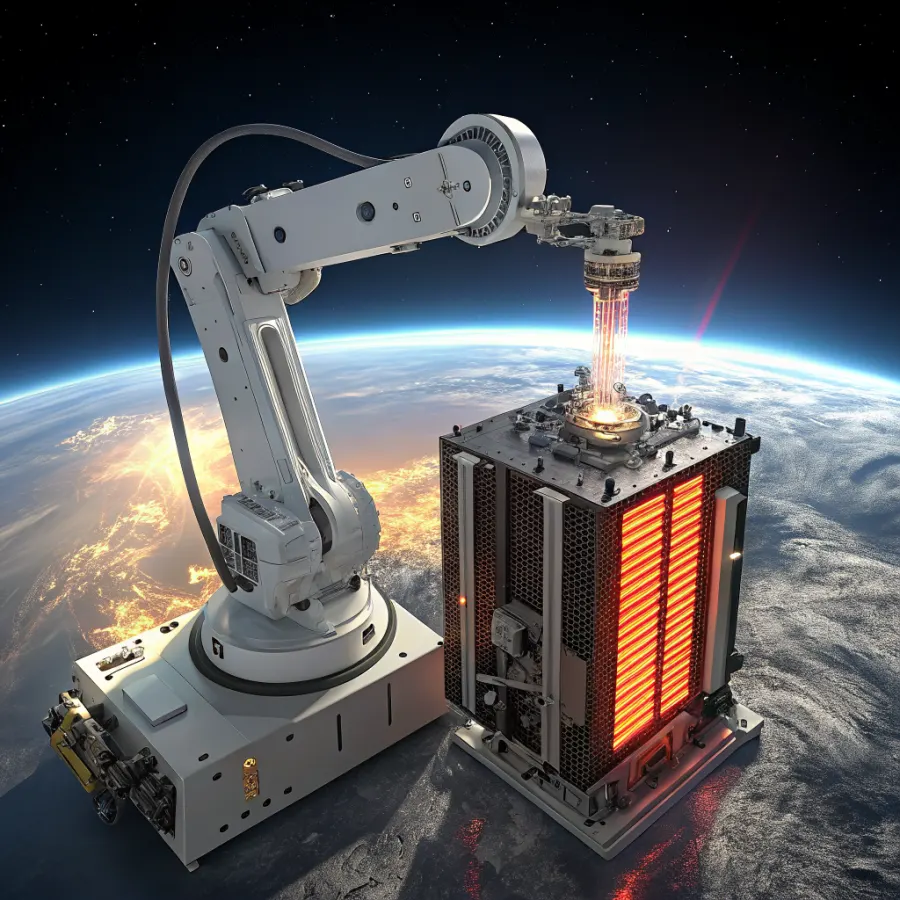
An AI server is basically a high-power electric stove. In a vacuum, that heat gets trapped in the chip unless it's actively radiated. The biggest engineering challenge of the "Over Cloud" isn't getting the servers up there; it's preventing them from melting. We're talking giant radiators and complex fluid systems to "spit" out the heat in the form of infrared radiation. If the cooling pump fails on Earth, the server shuts down; in space, it cooks in its own juice in seconds.
The Invisible Killer: Cosmic Rays
But let's assume we solve the heat problem. We're then faced with the silent sniper: radiation.
Down here, the atmosphere protects us. Up there, the servers are naked against cosmic rays and high-energy particles from the sun. For a silicon chip, this is lethal. A single charged particle that passes through a transistor can cause a Bit Flip (a change from 0 to 1 or vice versa).
Imagine you're training a critical financial or medical model. A bit flip in RAM could corrupt weeks of training or alter a diagnosis. On Earth, we use Error Correction Code (ECC) memory to mitigate this, but in orbit, the error rate skyrockets exponentially.
This forces us to rethink the hardware architecture:
- Physical Shielding: Adding lead or heavy polymers, which drastically increases the launch cost (putting weight into space is still expensive).
- Logical Redundancy: Having three processors doing the same calculation and "voting" on the correct result. If one disagrees due to radiation, it's discarded. This, of course, reduces the efficiency we're trying to achieve in the first place.
Is the Future Exospheric?
Despite the thermal and radiative challenges, the trend is clear. If AI continues to consume energy at its current rate, no power grid on Earth will be able to handle it. The "Exospheric Frontier" will stop being an academic paper and become critical infrastructure.
Maybe in five years, when you ask an AI to draft a contract or generate a video, the processing won't happen in a basement in Arizona, but in a metal box floating 400 kilometers above your head, powered by pure solar light, fighting against the heat of the vacuum, and dodging cosmic radiation to deliver your response.
 Larry
Larry
Comments
Be the first to comment.